
Introduction
Every business owner investing in paid advertising eventually asks the same question:
Should I spend my budget on Meta Ads or Google Ads?
In 2026, this debate is more important than ever. Both advertising platforms have evolved rapidly with AI-driven bidding, automation, advanced targeting, and stricter privacy regulations. As competition increases, choosing the wrong platform can waste thousands in ad spend.
However, the reality is simple: there is no universal winner.
The right platform depends on:
- Your business model
- Your audience behaviour
- Your products or services
- Your advertising goals
- Your budget and sales cycle
For example, a dental clinic trying to generate appointment bookings needs a completely different strategy compared to a furniture brand launching a visually-driven eCommerce campaign.
This expert guide compares Meta Ads vs Google Ads in 2026 using real-world benchmarks, ROI comparisons, industry use cases, pricing insights, and practical recommendations.
By the end of this article, you will know exactly:
- Which platform delivers better ROI
- Which one suits your industry
- When to use both together
- Common mistakes businesses make
- How to maximise ad performance in 2026
| Factor | Meta Ads | Google Ads | Winner |
|---|---|---|---|
| Audience Intent | Passive / Discovery | Active / Purchase-Ready | Google Ads |
| Average CPC (Global) | $0.50 – $2.00 | $1.00 – $6.00 | Meta Ads |
| Best for eCommerce | Strong (Product Discovery) | Very Strong (Shopping Ads) | Tie |
| Best for Lead Generation | Strong (Lead Forms) | Very Strong (High Intent) | Google Ads |
| Best for Brand Awareness | Excellent | Good | Meta Ads |
| Targeting Options | Interests, Behaviours, Lookalikes | Keywords, Intent, Audience | Meta Ads |
| Creative Requirement | High (Visual / Video) | Low (Text-Based) | Google Ads |
| Learning Curve | Moderate | Moderate–High | Meta Ads |
| Speed of Results | Fast (1–3 Days) | Fast (1–7 Days) | Tie |
| Long-Term ROI Potential | Good | Excellent | Google Ads |
What Are Meta Ads?
Meta Ads is the advertising platform behind Facebook, Instagram, Messenger, and Audience Network advertising.
In 2026, Meta continues to dominate social advertising with more than 3.2 billion daily active users across its ecosystem.
Unlike Google Ads, Meta Ads operate on an interruption-based marketing model. Users are not actively searching for products — instead, ads appear while they browse their social feeds.
As a result, Meta Ads excel at:
- Creating demand
- Building awareness
- Influencing buying decisions
- Driving impulse purchases
- Retargeting warm audiences
Simply put, Meta Ads are exceptional at putting your brand in front of the right people before they even realise they need your product.
Meta Ad Formats Available in 2026
1. Image & Carousel Ads
Perfect for showcasing products, services, and multiple offers in a visually engaging way.
Best For:
- Fashion brands
- Furniture stores
- Beauty products
- Restaurants
- Product storytelling
2. Video Ads & Reels
Short-form video continues to dominate social engagement in 2026.
Instagram Reels and Facebook video ads consistently outperform static creatives because they feel native to the platform.
Best For:
- Brand awareness
- Product demonstrations
- Personal branding
- Engagement campaigns
3. Lead Generation Ads
Meta Lead Ads allow users to submit their information without leaving Facebook or Instagram.
This reduces friction and often lowers cost-per-lead.
Best For:
- Real estate
- Local services
- Coaching businesses
- Clinics
- Agencies
4. Dynamic Product Ads
These ads automatically retarget users with products they previously viewed on your website.
Best For:
- Shopify stores
- WooCommerce stores
- Retargeting campaigns
- Cart abandonment recovery
5. Story Ads
Full-screen immersive ads shown inside Instagram and Facebook Stories.
Best For:
- Limited-time offers
- Flash sales
- Product launches
- Event promotions
6. Messenger Ads
Ads that open direct conversations with your business.
Best For:
- Appointment bookings
- Customer support
- Lead qualification
- WhatsApp-style selling
7. Advantage+ Shopping Campaigns
Meta’s AI-powered campaign structure designed specifically for eCommerce brands.
Best For:
- Automated scaling
- Product feeds
- Large inventories
- Dynamic targeting
Best Use Cases for Meta Ads
Meta Ads work exceptionally well for:
- Brand awareness campaigns
- Visual product marketing
- Retargeting visitors
- Community building
- Seasonal promotions
- Product launches
- Personal branding
- Low-ticket impulse purchases
- Social proof campaigns
Additionally, Meta’s audience targeting remains one of the strongest in digital advertising.
What Are Google Ads?
Google Ads is the world’s largest pay-per-click advertising platform.
Ads appear across:
- Google Search
- YouTube
- Google Shopping
- Gmail
- Google Maps
- Display Network
In 2026, Google processes over 8.5 billion searches daily, making it the most powerful platform for capturing buying intent.
The biggest difference between Meta Ads and Google Ads is intent.
When someone searches:
“Best dentist near me”
“Buy sofa online Islamabad”
“Digital marketing agency UK”
they are already looking for a solution.
That makes Google Ads extremely effective for:
- High-intent leads
- Local services
- eCommerce purchases
- B2B lead generation
- Emergency services
In other words, Google captures demand that already exists.
Google Ads Campaign Types in 2026
1. Search Campaigns
Text ads triggered by keywords users search on Google.
Best For:
- Lead generation
- Service businesses
- Local businesses
- High-intent traffic
2. Shopping Campaigns
Product listing ads showing:
- Product image
- Price
- Reviews
- Store name
Best For:
- eCommerce stores
- Retail brands
- Product searches
3. Display Campaigns
Banner ads shown across millions of websites.
Best For:
- Retargeting
- Brand awareness
- Remarketing
4. YouTube Ads
Video ads shown before or during YouTube videos.
Best For:
- Brand storytelling
- Product education
- Awareness campaigns
5. Performance Max Campaigns (PMax)
AI-powered campaigns that distribute ads across all Google channels automatically.
Best For:
- Automated optimisation
- Multi-channel reach
- eCommerce scaling
6. Local Service Ads
Pay-per-lead ads designed for local service providers.
Best For:
- Dentists
- Solicitors
- Electricians
- Clinics
- Plumbers
Best Use Cases for Google Ads
Google Ads are ideal for:
- Immediate lead generation
- High-intent traffic
- Local services
- B2B companies
- Emergency services
- Search-driven eCommerce
- High-ticket services
- Competitive industries
Moreover, Google Ads deliver some of the highest conversion rates in paid advertising because users already have purchase intent.
Key Differences Between Meta Ads and Google Ads
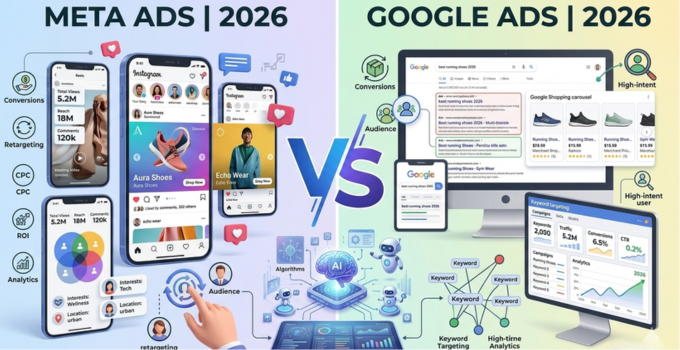
1. Audience Intent
Google Ads
Google users are actively searching for solutions.
That means they are often closer to making a purchase.
Example:
Someone searching:
“Immigration lawyer Bradford”
is likely ready to contact a business immediately.
Meta Ads
Meta users are browsing social feeds casually.
Therefore, Meta excels at:
- Discovery
- Inspiration
- Awareness
- Retargeting
This makes Meta ideal for introducing products users were not initially searching for.
2. Targeting Options
Meta Ads Targeting
Meta provides advanced targeting using:
- Interests
- Behaviours
- Demographics
- Lookalike audiences
- Custom audiences
As a result, advertisers can target highly specific customer profiles.
Google Ads Targeting
Google primarily targets based on:
- Search intent
- Keywords
- In-market audiences
- Remarketing behaviour
While demographic targeting is less advanced than Meta, buyer intent is significantly stronger.
3. Cost Per Click (CPC)
| Platform | Average CPC (Global) | Average CPC (Pakistan) | Average CPC (UK) |
|---|---|---|---|
| Meta Ads | $0.50 – $2.00 | ₨5 – ₨40 | £0.30 – £1.50 |
| Google Ads (Search) | $1.00 – $6.00 | ₨20 – ₨120 | £0.80 – £5.00 |
| Google Shopping | $0.40 – $1.20 | ₨10 – ₨50 | £0.30 – £1.00 |
Although Meta Ads usually have lower CPCs, Google Ads often generate better-quality traffic.
4. Conversion Rates
Google Search Ads generally produce higher conversion rates because of stronger intent.
Typical Conversion Benchmarks:
| Platform | Average Conversion Rate |
|---|---|
| Google Search Ads | 3% – 8% |
| Meta Ads | 1% – 3% |
However, Meta performs extremely well for:
- Impulse purchases
- Fashion
- Beauty
- Lifestyle products
5. Creative Requirements
Meta Ads
Meta is a creative-first platform.
Strong visuals and videos are essential.
Poor creative quality usually results in:
- Low engagement
- High CPC
- Weak conversions
Google Ads
Google Search Ads are mostly text-based.
Success depends more on:
- Keyword targeting
- Ad copywriting
- Landing page quality
6. Attribution & Tracking
Tracking has become more difficult in 2026 due to:
- iOS privacy updates
- Cookie restrictions
- Browser tracking limitations
Best Practice:
Use:
- Google Tag Manager
- GA4
- Meta Conversions API (CAPI)
- Server-side tracking
This significantly improves attribution accuracy.
ROI Comparison by Business Type in 2026
eCommerce Stores
Both platforms are powerful for eCommerce — but they serve different purposes.
Google Ads Strengths
- Captures high-intent buyers
- Shopping Ads convert strongly
- Excellent for branded searches
Meta Ads Strengths
- Product discovery
- Retargeting
- Impulse purchases
- New collection launches
Recommended Strategy:
Use:
- Google Shopping for purchase intent
- Meta Ads for discovery and retargeting
Local Businesses
Local businesses often see faster ROI from Google Ads.
Why?
Because users search with immediate intent:
- “Dentist near me”
- “Best salon in Bradford”
- “Emergency plumber”
Recommended Strategy:
- Google Ads for lead generation
- Meta Ads for awareness and promotions
Lead Generation Businesses
For agencies, consultants, solicitors, and service providers:
Google Search Ads usually outperform Meta in lead quality.
Why?
Because search intent is stronger.
Recommended Strategy:
- Google Ads as primary acquisition channel
- Meta Lead Ads as secondary volume source
SaaS Businesses
SaaS companies benefit from combining both platforms.
Google Ads:
Captures active software buyers.
Meta Ads:
Supports retargeting and awareness campaigns.
Personal Brands & Coaches
Meta Ads are usually the better option for:
- Coaches
- Course creators
- Influencers
- Webinar funnels
The visual nature of Instagram and Facebook helps build trust before selling.
When Meta Ads Deliver Better ROI
Meta Ads often outperform Google Ads when:
- Selling visual products
- Building awareness
- Promoting launches
- Retargeting warm audiences
- Growing communities
- Running seasonal offers
- Targeting specific demographics
- Selling low-ticket impulse products
When Google Ads Deliver Better ROI
Google Ads typically outperform Meta Ads when:
- Users already search for the product
- Leads are high-intent
- Services are urgent
- The market is highly competitive
- Businesses rely on local searches
- Products involve long research cycles
Why Using Both Platforms Together Works Best
The highest-performing businesses in 2026 rarely rely on one platform alone.
Instead, they use:
- Meta Ads for awareness
- Google Ads for conversion
This creates a full-funnel marketing system.
Full-Funnel Advertising Strategy
| Funnel Stage | Best Platform | Objective | Ad Type |
|---|---|---|---|
| Awareness | Meta Ads | Reach & Awareness | Video / Reels |
| Consideration | Meta + Google Display | Engagement | Carousel / Display |
| Decision | Google Search | Conversion | Search / Shopping |
| Retention | Meta Ads | Repeat Purchases | Dynamic Retargeting |
Cost Comparison: Meta Ads vs Google Ads in 2026
| Metric | Meta Ads | Google Search Ads | Google Shopping |
|---|---|---|---|
| Average CPC (UK) | £0.30 – £1.50 | £0.80 – £5.00 | £0.30 – £1.20 |
| Average CPM (UK) | £4 – £12 | N/A | N/A |
| Average CPA (Lead Gen) | £15 – £60 | £20 – £80 | N/A |
| Average CPA (eCommerce) | £8 – £35 | £10 – £40 | £5 – £25 |
| Average ROAS (eCommerce) | 2x – 5x | 3x – 8x | 4x – 10x |
| Minimum Daily Budget | £5 | £10 | £10 |
Pros and Cons of Meta Ads
Pros
- Lower CPC
- Excellent audience targeting
- Strong retargeting capabilities
- Great for brand storytelling
- Powerful for visual products
- Effective for awareness campaigns
Cons
- Lower purchase intent
- Creative fatigue happens quickly
- Tracking issues after iOS updates
- Requires strong creatives consistently
Pros and Cons of Google Ads
Pros
- High-intent traffic
- Strong conversion rates
- Excellent for local businesses
- Better lead quality
- Shopping Ads drive strong eCommerce ROI
- Accurate GA4 integration
Cons
- Higher CPC
- Requires keyword expertise
- Competitive industries can be expensive
- Smart bidding needs sufficient data
Common Mistakes Businesses Make
1. Sending Traffic to the Homepage
A homepage is not designed for conversions.
Instead, use a dedicated landing page matching the ad message.
2. Poor Tracking Setup
Broken conversion tracking leads to misleading data.
Always verify:
- Pixel events
- GA4 tracking
- Conversion actions
- Attribution settings
3. Weak Meta Creatives
Low-quality visuals increase costs dramatically.
In 2026:
- Reels outperform static images
- Authentic videos outperform stock footage
4. Ignoring Negative Keywords
Without negative keywords, Google wastes budget on irrelevant traffic.
5. Not Testing Enough
Successful advertisers constantly test:
- Creatives
- Headlines
- Audiences
- Offers
- Landing pages
Continuous optimisation is critical.
Expert Recommendations for 2026
Budget Allocation by Business Type
| Business Type | Meta Ads | Google Ads |
|---|---|---|
| New Business | 60% | 40% |
| Growing Business | 40% | 60% |
| Established Business | 35% | 65% |
| eCommerce Brand | 50% | 50% |
| Local Service Business | 30% | 70% |
| Personal Brand / Coach | 70% | 30% |
Testing Strategy
To improve ROI:
- Run campaigns for at least 4 weeks
- Test one variable at a time
- Use multiple creatives
- Analyse conversion quality — not just CPC
- Scale gradually
Scaling Strategy
Meta Ads
Increase budgets by no more than 20% every 72 hours.
Google Ads
Scale after:
- 50+ monthly conversions for Target CPA
- 100+ conversions for Target ROAS
Frequently Asked Questions (FAQs)
Q1: Is Meta Ads or Google Ads better for small businesses?
Local service businesses usually perform better on Google Ads because of high-intent traffic. However, product-based businesses often see excellent results with Meta Ads due to lower CPC and visual engagement.
Q2: Which platform has lower cost per lead in 2026?
Meta Ads generally produce cheaper leads, but Google Ads often generate higher-quality leads that convert better into customers.
Q3: Can I run both platforms with a small budget?
Yes. However, budget allocation should match your business objective. Service businesses should prioritise Google Ads, while awareness-focused brands may benefit more from Meta Ads initially.
Q4: Why am I getting clicks but no conversions on Google Ads?
Common reasons include:
- Poor landing pages
- Wrong keyword intent
- Weak offer
- Slow website speed
- Poor tracking setup
Q5: Why do Meta Ads generate messages but not sales?
Messages are not purchases.
The issue is often:
- Slow follow-up
- Weak qualification
- Broad targeting
- Poor sales process
Q6: Which platform is best for real estate?
Real estate businesses benefit from using both platforms together:
- Google captures intent
- Meta showcases properties visually
Q7: How much should beginners spend on Google Ads?
Recommended Starting Budgets:
- Pakistan: ₨15,000–₨30,000/month
- UK: £300–£500/month
This provides enough data for optimisation.
Q8: What is a good ROAS in 2026?
General Benchmarks:
- Meta Ads: 3x–5x ROAS
- Google Shopping: 4x–10x ROAS
For service businesses, CPA matters more than ROAS.
Conclusion: Which Platform Should You Choose?
The Meta Ads vs Google Ads debate is not about choosing a universal winner.
Instead, it is about choosing the right platform for your:
- Goals
- Industry
- Customer journey
- Budget
- Sales process
Here is a simplified framework:
| Goal | Best Platform |
|---|---|
| Immediate Leads | Google Ads |
| Brand Awareness | Meta Ads |
| Visual Product Sales | Meta + Google Shopping |
| Local Search Dominance | Google Ads |
| Retargeting | Meta Ads |
| Coaching / Personal Brands | Meta Ads |
| B2B Lead Generation | Google Ads |
| Long-Term Growth | Both Together |
Ultimately, the businesses that dominate in 2026 are the ones using both platforms strategically — not choosing sides.
The winning formula is:
- Strong creatives
- Smart targeting
- Accurate tracking
- Conversion-focused landing pages
- Full-funnel strategy
Need Help Running Meta Ads or Google Ads?
Esols Digital Agency helps businesses in the UK and Pakistan generate better ROI with:
- Meta Ads Management
- Google Ads Management
- eCommerce Advertising
- Landing Page Optimisation
- Conversion Tracking Setup
Contact Esols Digital Agency today for a free advertising audit and growth strategy consultation.
