
Table of contents
- The Numbers Behind Tesla’s Brand Crisis
- 8 Brand Reputation & Digital Marketing Lessons for UK Businesses
- Lesson 1: Your Founder IS Your Brand — That’s a Double-Edged Sword
- Lesson 2: Existing Customers Are Not a Safety Net
- Lesson 3: Social Media Silence in a Crisis Costs More Than Speaking Up
- Lesson 4: The Algorithm Doesn’t Care About Brand Legacy
- Lesson 5: Paid Advertising Cannot Compensate for a Broken Brand
- Lesson 6: Competitor Gains Are Permanent — Act Before They Take Your Customers
- Lesson 7: Your Reputation Lives in Search, Not Just in Social
- Lesson 8: Diversification of Marketing Channels Is Not Optional
- Frequently Asked Questions
- Conclusion: Brand Reputation Is a Business Asset — Protect It Accordingly
On 12 June 2026, Elon Musk became the first person in history to hold a net worth exceeding one trillion dollars — a milestone celebrated across global headlines. Fourteen days later, that same fortune had shrunk by more than $160 billion. Tesla shares dropped over 40% in a single quarter. Dealerships reported vandalised vehicles across Europe and North America. In the UK, Tesla sales fell 61% year-on-year in early 2026.
This is not a story about one eccentric billionaire. It is a story about what happens when brand reputation breaks down — and what every UK business owner, ecommerce seller, and digital marketer must do differently as a result.
We have pulled out eight concrete, actionable lessons from the Tesla situation that apply directly to UK businesses operating in 2026. Every point comes with something you can act on this week.
The Numbers Behind Tesla’s Brand Crisis
Before the lessons, here is what happened — because the scale of this matters for what follows.
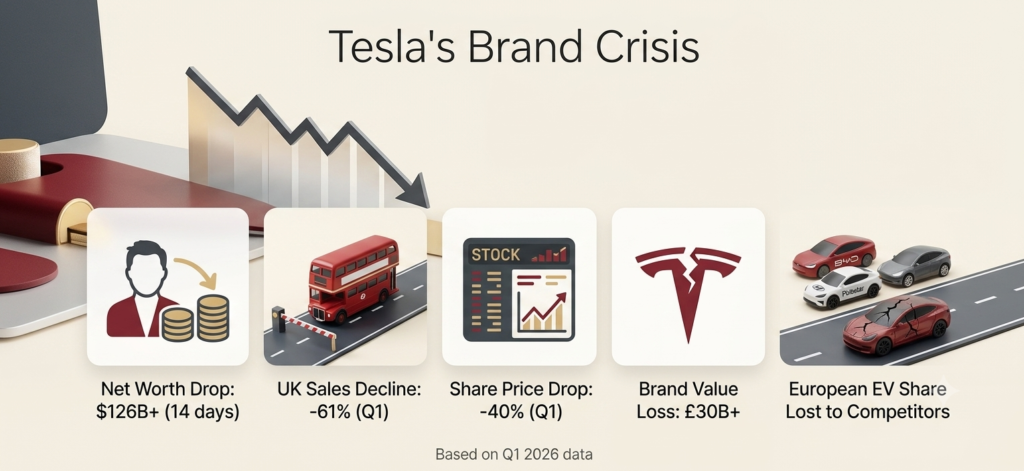
| Metric | Figure |
| Elon Musk net worth drop (June 2026) | $126B+ in 14 days |
| Tesla UK sales decline (Q1 2026 vs Q1 2025) | -61% year-on-year |
| Tesla share price drop (Q1 2026) | -40% in the quarter |
| Tesla brand value loss (estimated) | £30B+ |
| European EV market share Tesla lost | Significant ground to BYD, Polestar, and Hyundai |
8 Brand Reputation & Digital Marketing Lessons for UK Businesses
Lesson 1: Your Founder IS Your Brand — That’s a Double-Edged Sword
When Elon Musk’s political activities in the US and Europe became a flashpoint in 2025, buyers did not separate Tesla the car from Musk the person. For many customers, the brand and the founder were the same thing — and when one became toxic, both did.
UK business owners who are strongly identified as the face of their company should ask a hard question: if your personal views or actions attracted controversy tomorrow, does your business have its own brand identity that would survive independently? If the answer is no, it is time to build one.
• Build a brand identity that has depth beyond the founder’s personality
• Separate company social media accounts from personal ones with clear boundaries
• Invest in team-based content: case studies, employee spotlights, customer testimonials that don’t depend on any one person
Lesson 2: Existing Customers Are Not a Safety Net
Tesla’s loyal fanbase was vocal on social media but silent in the showroom. Q1 2026 delivery numbers told the truth: existing owners did not replace their Teslas, and new buyers chose alternatives. Brand loyalty does not automatically convert into repeat purchase when the brand experience feels compromised.
For ecommerce and digital businesses in the UK, this means your retention strategy must be active, not passive. A newsletter, a loyalty programme, a re-engagement sequence — these are not nice-to-haves. They are insurance.
• Run quarterly re-engagement campaigns to previous customers
• Use review and testimonial collection as part of your post-purchase sequence
• Track repeat purchase rate as a KPI alongside acquisition costs
Lesson 3: Social Media Silence in a Crisis Costs More Than Speaking Up
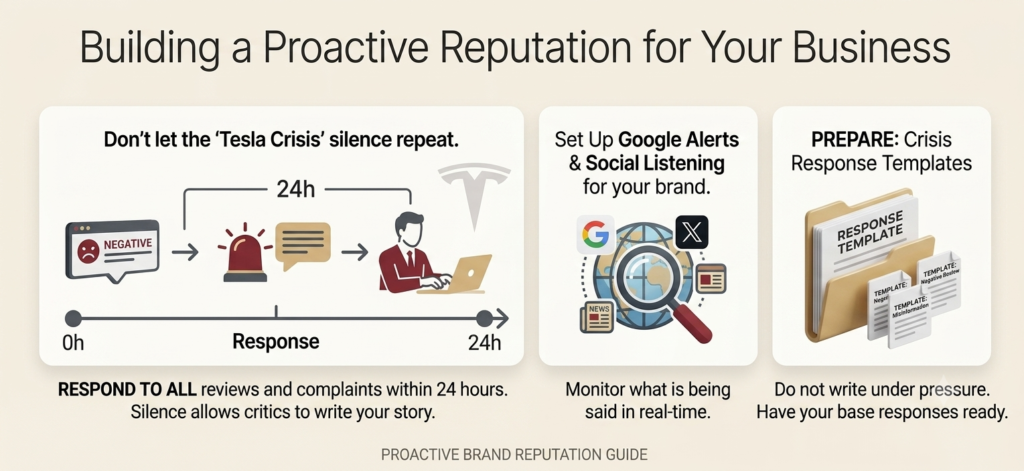
During the worst weeks of the Tesla story, the official @Tesla account posted product updates while the internet was ablaze with boycott hashtags. The absence of a considered response allowed the narrative to be written entirely by critics.
UK businesses often make this mistake at a smaller scale: a negative review goes unanswered, a social media complaint sits idle for three days, or a misinformation post about the business goes unchallenged. Every hour of silence is permission for someone else to shape your reputation.
• Respond to all reviews — positive and negative — within 24 hours
• Set up Google Alerts and social listening for your brand name
• Prepare a basic crisis response template so you are not writing from scratch under pressure
Lesson 4: The Algorithm Doesn’t Care About Brand Legacy
Tesla’s SEO rankings for terms like ‘best electric car UK’ slipped as competitor content improved and negative press dominated the search results. Years of brand authority did not protect organic visibility when the content landscape shifted.
For UK businesses in 2026, search is increasingly shaped by AI overviews, featured snippets, and entity-based ranking signals. A strong domain from 2021 does not automatically rank in 2026 without fresh, authoritative, well-structured content.
• Publish at least two long-form, expert-level articles per month
• Update high-performing content annually with fresh data and examples
• Build topical authority clusters rather than isolated blog posts
Lesson 5: Paid Advertising Cannot Compensate for a Broken Brand
Tesla dramatically reduced its advertising spend in 2024, then scrambled to increase it in 2026 as sales fell. The problem: no amount of spend can purchase back trust once it has been lost. Customers who had decided not to buy a Tesla were not going to reverse that decision because they saw a YouTube pre-roll.
Paid media amplifies what already exists. If the underlying brand perception is negative, PPC and social ads accelerate awareness of that negativity. ESOLS consistently advises clients: fix the brand first, then increase the spend.
• Audit your Google and Meta reviews before scaling ad spend
• Ensure landing pages reflect the same trust signals as your ad creative
• Use retargeting to re-engage warm audiences before cold acquisition
Lesson 6: Competitor Gains Are Permanent — Act Before They Take Your Customers
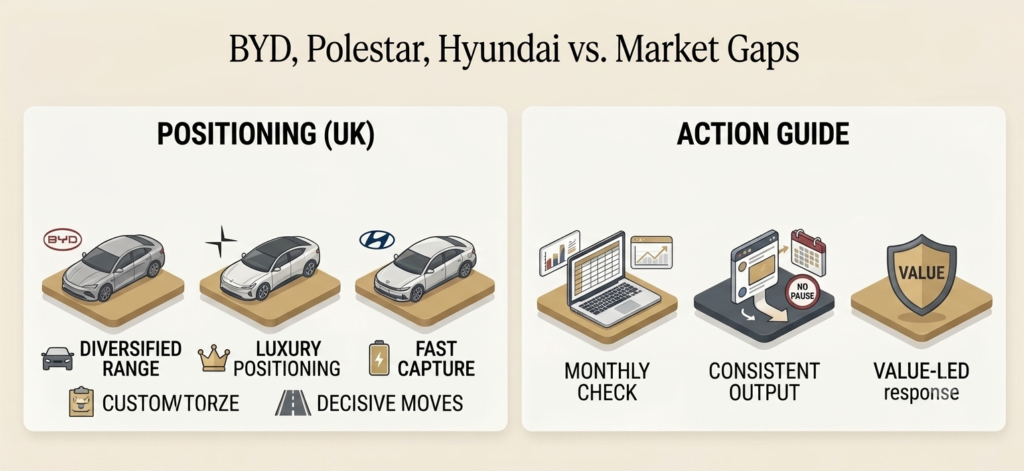
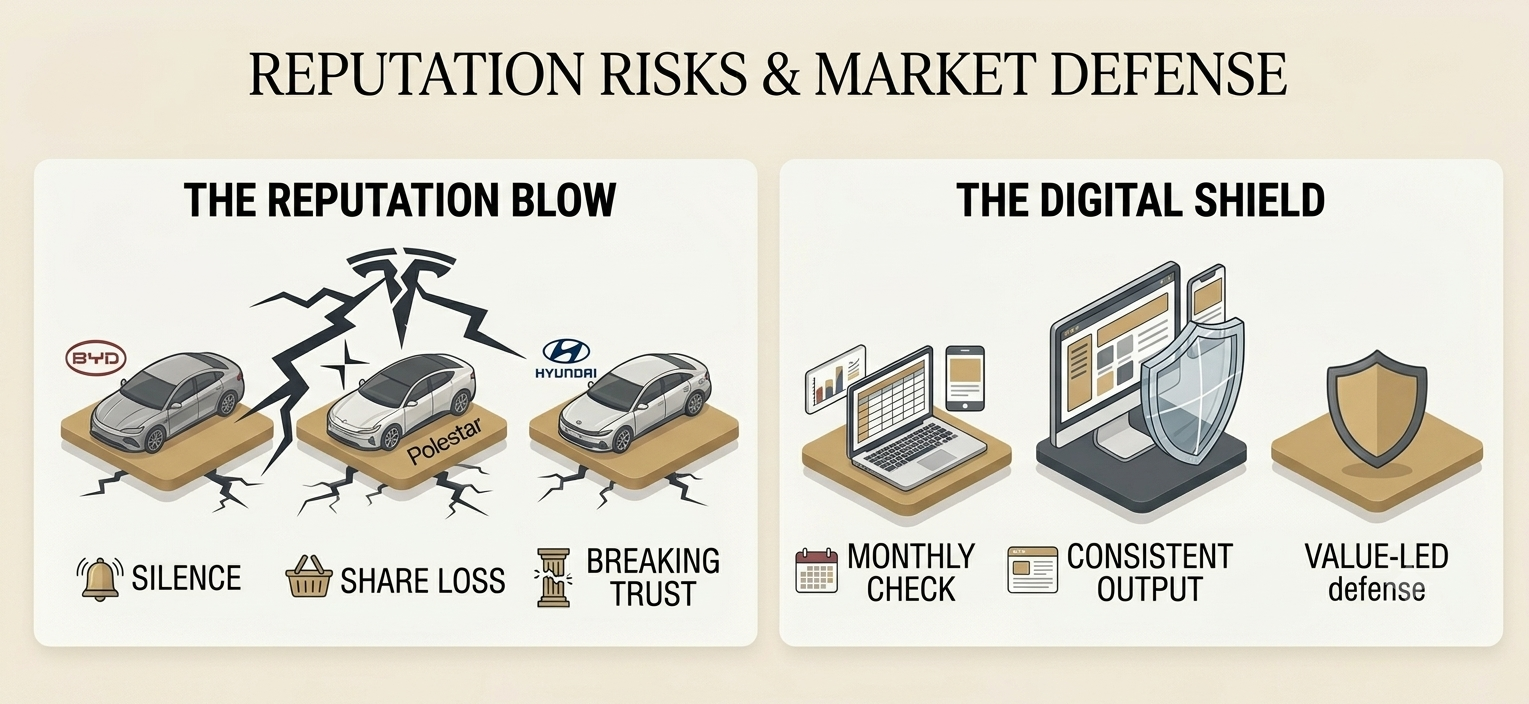
BYD, Polestar, and Hyundai did not create Tesla’s crisis — but they moved quickly and decisively to benefit from it. By the time Tesla stabilised its brand messaging, the competitors had captured buyers who might otherwise have waited.
In your market, there are competitors watching your customers. If your marketing slows down, your content goes quiet, or your customer experience dips, they will fill the gap. UK digital marketing cannot be paused and resumed without cost.
• Keep a competitor monitoring sheet — track their content, promotions, and positioning monthly
• Be consistent with content and social output even during quiet business periods
• Respond to competitor gains with value-led content, not panic discounting
Lesson 7: Your Reputation Lives in Search, Not Just in Social
When UK buyers searched ‘Tesla reliability 2026’, the top results were not Tesla’s own pages. They were news articles, owner forums, consumer reports, and YouTube videos — almost all negative. Tesla had no SEO strategy for reputation management, so it had no ability to influence what buyers found when they looked.
Managing your reputation in search means proactively creating content that ranks for branded and semi-branded queries. It means getting third-party coverage, case studies, and testimonials that appear when prospects research your business.
• Create a dedicated ‘results’ or ‘case studies’ section on your website
• Build links from UK-relevant industry publications and directories
• Encourage satisfied customers to leave reviews on Google, Trustpilot, and relevant platforms
Lesson 8: Diversification of Marketing Channels Is Not Optional
Tesla’s over-reliance on Musk’s X (Twitter) for brand communication became a liability the moment his personal credibility became contested. A strategy built on one channel — whether that’s Instagram, TikTok, Amazon organic, or a single PPC source — is brittle.
UK businesses that generate 80%+ of revenue from one channel (often Google Ads or one Amazon marketplace) face the same systemic risk. ESOLS consistently helps clients build multi-channel marketing ecosystems that are more resilient and more profitable over time.
• Map your current revenue by channel and identify any single point of failure
• Introduce at least one new traffic or sales channel each quarter
• Build owned assets: email list, organic search traffic, SMS — not just rented platforms
Frequently Asked Questions
In June 2026, Musk’s net worth dropped by more than $126 billion in approximately 14 days following market movements and a broader decline in Tesla’s share price and brand value. He remains among the wealthiest people on the planet, but the speed and scale of the drop became one of the most discussed business stories of the year.
Multiple factors converged: consumer boycotts linked to Musk’s political activities, a stronger competitive field from BYD, Polestar, and Hyundai, and a broader perception that Tesla’s edge in technology had narrowed. UK sales reportedly fell 61% year-on-year in early 2026.
ESOLS offers a full suite of digital marketing and reputation management services for UK businesses across ecommerce, B2B, and professional services. From SEO and content strategy to social media management and PPC, the ESOLS team builds marketing ecosystems that are resilient, data-driven, and built for long-term growth. Contact the team at esols.net/contact for a free consultation.
Conclusion: Brand Reputation Is a Business Asset — Protect It Accordingly
The Tesla story is not a cautionary tale about one company. It is a case study in how quickly brand equity — built over years of innovation, community, and premium positioning — can erode when the fundamentals of reputation management are neglected.
For UK businesses in 2026, the lesson is not to avoid bold marketing or strong positioning. It is to build marketing infrastructure that is resilient: multiple channels, proactive reputation monitoring, consistent content production, and a brand identity that can stand independently of any single person, platform, or trend.
Trust eroded among exactly the customers Tesla needed most to win over. Competitors paid attention and filled the gap. The underlying product remained good, but good products alone do not close sales when trust is gone.
ESOLS has helped 400+ businesses across the UK, US, and beyond grow their digital presence without making the avoidable mistakes that derail bigger brands. If you want a free review of your current brand reputation and digital marketing strategy, get in touch with the ESOLS team today.
| Ready to Build a Brand That Holds Its Value?Book your free digital marketing consultation with the ESOLS team.Visit: esols.net/contact | Email: Sales@esols.net | UK: Unit 13-14 Upper Villier Street, Wolverhampton |
Tags: brand reputation management, digital marketing 2026, Tesla brand crisis, Elon Musk net worth, online reputation management UK, ecommerce brand strategy, social media marketing, UK digital marketing agency
© 2026 ESOLS Technologies. All rights reserved. | esols.net
