
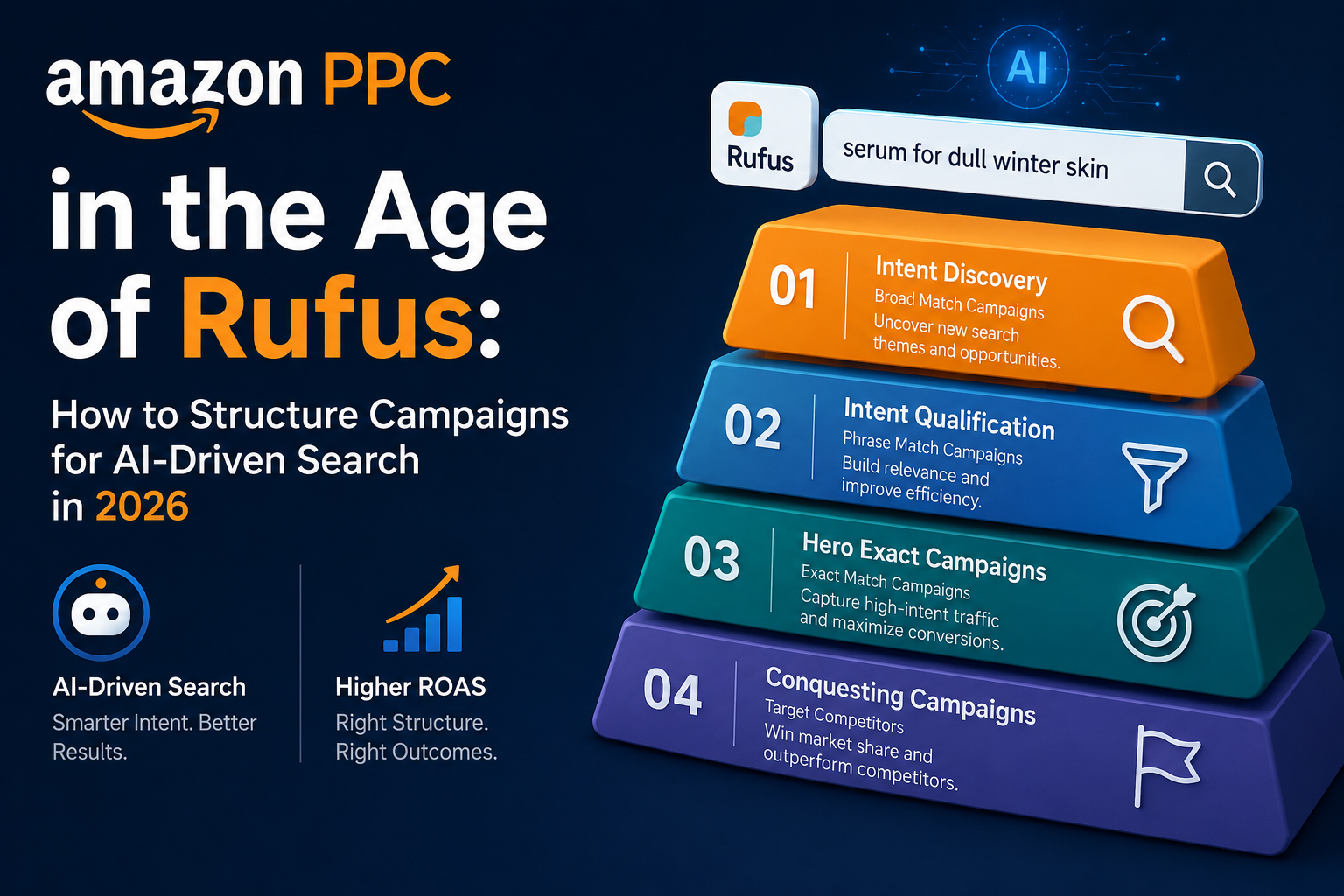
If you are still building Amazon PPC campaigns the way you did in 2024, you are literally burning cash.
In 2026, Amazon is no longer a keyword-matching machine. It is an AI-driven intent engine powered by Rufus. This large language model sits between your product and the customer. It interprets what the shopper actually means, not just the exact words they type.
The result? Old-school PPC strategies (exact match, broad match, and heavy keyword stuffing) are now generating high impressions but low conversion rates.
Here is the hard truth: You cannot out-bid Rufus. You have to out-optimize for it.
In this guide, I will show you exactly how to restructure your Amazon PPC campaigns to work with Rufus AI, not against it.
What is Rufus AI and Why Does It Break Your Old Strategy?
Rufus is Amazon’s generative AI shopping assistant. It is embedded directly into the Amazon search bar and product detail pages.
Here is what Rufus does differently:
- Instead of matching “stainless steel water bottle 32oz” it understands “durable bottle for hiking that keeps ice all day.”
- It summarizes customer reviews, analyzes product specifications, and compares features across thousands of listings in milliseconds.
- It then recommends products based on conversational intent, not keyword density.
Because of Rufus, Amazon PPC CPCs have increased 18–32% year-over-year. Why? Because advertisers who rely on outdated keyword match types are bidding on the wrong traffic. Rufus shows their ads to the wrong audience, they get clicks, but no sales. That increases competition and drives up costs for everyone.
If your PPC structure still looks like a Google Ads account from 2019, you are losing money.
The 2026 Rufus-Ready PPC Structure
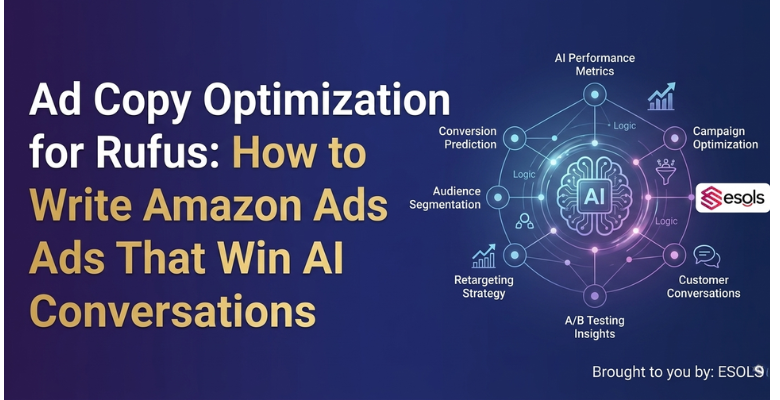
Stop building campaigns around match types. Start building them around search intent themes.
Here is the exact four-layer structure we use for our clients:
Layer 1: Intent Discovery Campaigns (Broad Match + Rufus Signals)
What it is: A single campaign with broad match keywords only. No negative keywords initially.
Why it works for Rufus: Rufus needs data to learn. Broad match allows Amazon’s AI to explore related searches you never thought of. For example, if you sell “wool socks,” Rufus might match you with “cold feet remedy” or “cabin socks for winter.”
Budget allocation: 10–15% of daily spend
Optimization rule: Run for 7 days. Export search term reports. Look for patterns, not individual terms. Group themes.
Layer 2: High-Intent Phrase Campaigns
What it is: Phrase match keywords built from the themes discovered in Layer 1.
Why it works for Rufus: Once Rufus understands what your product actually solves, phrase match locks in the most profitable conversational queries. Think “socks for diabetic swelling” rather than “diabetic socks.”
Budget allocation: 40–50% of daily spend
Optimization rule: Target 3–5 word phrases that contain problem-solution language, not just product attributes.
Layer 3: Exact Match Hero Campaigns
What it is: Exact match for your highest-converting, brand-specific, and top-of-funnel commercial terms.
Why it works for Rufus: By the time you reach this layer, Rufus already knows exactly who should see your ad. Exact match now acts as a conversion catcher, not a discovery tool.
Budget allocation: 30–40% of daily spend
Optimization rule: Only include terms that have historically generated a TACoS below your target. If a keyword has a high ACoS but low TACoS, move it back to Layer 2.
Layer 4: Competitor Conquesting with Context
What it is: Sponsored Brands and Sponsored Display campaigns targeting competitor ASINs and brand-related keywords.
Why it works for Rufus: Rufus compares products transparently. If your listing is genuinely better (better reviews, better value, better features), Rufus will surface you when a shopper asks “compare [competitor brand] vs similar.”
Budget allocation: 10% of daily spend
Optimization rule: Only conquest if your product has a clear, verifiable advantage. Rufus reads reviews. If your rating is lower than the competitor, do not run this campaign.
The New Optimization Playbook for Rufus
Forget daily bid adjustments based on ACoS alone. Here is what matters now:
1. Optimize Listing Semantic Density, Not Keyword Stuffing
Rufus reads your entire listing like a human. Write naturally. Use bullet points that answer specific questions:
- Old way: “32oz, stainless steel, vacuum insulated, leakproof”
- Rufus-ready way: “Keeps water cold for 24 hours during hiking, gym sessions, or long work shifts. The 32oz size fits most car cup holders.”
2. Use Backend Search Fields for Context, Not Repetition
Amazon’s backend search terms are now read by Rufus as contextual clues. Do not repeat your title. Instead, add:
- Usage scenarios (gift, travel, office, camping)
- Problem statements (leaks, sweating, broken lids)
- Comparison qualifiers (better than yeti, similar to stanley)
3. Measure TACoS, Ignore Isolated ACoS
Rufus creates halo effects. A shopper might click your ad for a “camping stove” but end up buying your “camping fuel” organically. If you only look at ACoS, the stove campaign looks bad. But your total business profit (TACoS) is up.
New rule of thumb: If your TACoS stays flat or drops while total sales increase, your PPC is working even if individual campaign ACoS looks high.
Learnmore: Amazon Advertising Guide
Real Example: How We Fixed a Beauty Brand in 30 Days
A skincare client came to us in February 2026. Their Amazon CPC had climbed to $2.30. Their ACoS was 42%. They were losing money on every sale.
Their old agency was running only exact match campaigns on terms like “vitamin c serum” and “retinol cream.”
We switched to the Rufus-ready four-layer structure:
- Week 1: Launched Intent Discovery (broad match) – spent $500, found 47 new search themes including “serum for dull winter skin” and “retinol that doesn’t burn.”
- Week 2: Moved high-performing themes to Phrase campaigns – CPC dropped to $1.80 as relevance improved.
- Week 3: Added Hero Exact campaigns for top themes – ACoS fell to 28%.
- Week 4: Launched Conquesting against weaker competitors – overall TACoS dropped from 18% to 12%.
Result: Same monthly ad spend. 34% more total sales. Positive margin for the first time in six months.
Common Rufus Mistakes to Avoid
| Mistake | Why It Hurts |
|---|---|
| Using the same campaign structure for all products | Rufus treats each category differently. Beauty and furniture have completely different search intent patterns. |
| Negating “low converting” keywords too fast | Rufus often requires 10–15 clicks to learn intent. A keyword that fails after 5 clicks might be your best performer after 20. |
| Ignoring review sentiment | Rufus reads star ratings and review text. A well-optimized PPC campaign cannot save a 3.5-star product. Fix your product first. |
| Treating Walmart and Amazon the same | Sparky (Walmart AI) and Rufus work differently. Strategies are not transferable. |
Final Takeaway
Amazon PPC in 2026 is not harder. It is just different.
The old advantage was bigger budgets. The new advantage is alignment with AI intent.
You do not need to spend more. You need to restructure how you spend.Amazon PPC in the Age of Rufus is totalyy chanegd.
Start with the four-layer intent framework. Measure TACoS. Write for humans and Rufus together. If you do that, you will capture traffic that your competitors are literally paying to miss.
Need Help Structuring Your Rufus-Ready Campaigns?
We audit Amazon PPC accounts specifically for AI-driven search compatibility. One hour of analysis can identify where your budget is leaking.
Contact us for a free Rufus readiness score and a custom campaign structure for your top three product families.
