
If you’re selling on Amazon — or seriously thinking about it — there’s a decision you’ll face before you ship your first unit: FBA or FBM?
These two letters are responsible for more seller confusion, miscalculated margins, and lost profit than almost any other Amazon decision. Get it wrong and you could be paying warehouse fees on slow-moving inventory, losing the Buy Box to faster competitors, or drowning in customer service messages while running your own fulfilment operation.
Get it right and you unlock Amazon’s ecosystem, streamline your operations, and scale without proportionally scaling your headaches.
This guide breaks down Amazon FBA vs FBM in plain terms — covering fees, logistics, control, Buy Box impact, and profitability — so you can make the decision that’s right for your specific products, budget, and business model. We’ll also cover a third option that most sellers overlook.
What Is Amazon FBA (Fulfillment by Amazon)?

Amazon FBA
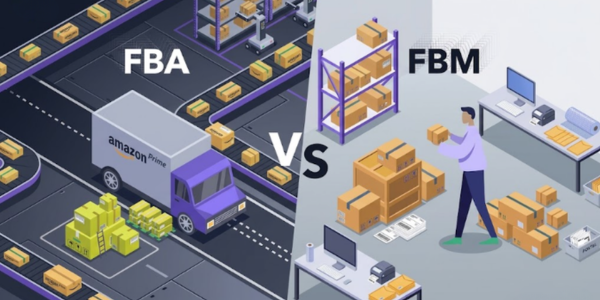
Fulfillment by Amazon (FBA) means you send your inventory to Amazon’s warehouses, and Amazon takes care of the rest — storing products, picking and packing orders, shipping to customers, and handling returns and customer service.
In exchange, you pay Amazon fulfillment fees on every unit sold, plus monthly storage fees for the space your products occupy in their warehouses.
How FBA Works — Step by Step
- You create product listings in Seller Central
- You ship inventory to Amazon’s designated fulfilment centres
- When a customer orders, Amazon picks, packs, and ships the item
- Amazon handles all customer service and returns
- You receive your payment (minus fees) every two weeks
The appeal is obvious: you essentially outsource your logistics to the world’s most advanced fulfilment network. Your products are eligible for Prime, giving them the iconic badge that drives purchase decisions for tens of millions of Amazon shoppers.
What Is Amazon FBM (Fulfillment by Merchant)?
Fulfillment by Merchant (FBM) means you are responsible for storing, packing, and shipping every order yourself — or through a third-party logistics provider. You retain full control of your supply chain but take on the full operational burden.
With FBM, Amazon’s role is primarily the marketplace — they list your products, process the payments, and provide the platform. Everything after the click is down to you.
How FBM Works — Step by Step
- You create product listings in Seller Central
- You store inventory in your own warehouse, home, or 3PL
- When a customer orders, Amazon notifies you
- You pick, pack, and ship the item within your stated handling time
- You manage all customer service and returns
- You receive payment minus Amazon’s referral fee
FBM sellers can still access Prime through Seller Fulfilled Prime (SFP), though Amazon’s requirements for SFP are demanding — you must maintain a pre-fulfilment cancellation rate below 0.5%, a valid tracking rate above 99%, and same-day or next-day dispatch capability.
FBA vs FBM: The Core Differences at a Glance
| Factor | FBA | FBM |
| Fulfillment | Amazon handles everything | You handle everything |
| Prime Eligibility | Automatic – all listings | SFP only (strict criteria) |
| Storage | Amazon warehouses | Your own / 3PL |
| Customer Service | Amazon manages | You manage |
| Returns Processing | Amazon manages | You manage |
| Ongoing Fees | Fulfilment + storage fees | Referral fee only |
| Seller Control | Lower | Higher |
| Scalability | Very high | Depends on your logistics |
| Buy Box Advantage | Significant | Moderate (unless SFP) |
Breaking Down the Costs: FBA vs FBM Fees in 2026
This is where the decision gets real. Neither model is inherently cheaper — it entirely depends on your product dimensions, weight, sales velocity, and storage turnover.
Amazon FBA Fees — UK Market, 2026
Fulfillment Fees are charged per unit and vary by size tier:
| Size Tier | Example Dimensions | Est. Fee (UK) |
| Small envelope | ≤20×15×1 cm, ≤80g | £2.70 – £3.20 |
| Standard envelope | ≤33×23×2.5 cm, ≤490g | £3.50 – £4.80 |
| Standard parcel | ≤45×34×26 cm, ≤12kg | £5.10 – £8.40 |
| Large parcel | ≤61×46×46 cm, ≤30kg | £11.20 – £24.50 |
| Oversize | Anything larger | Custom quote |
Note: Amazon updates its fee schedule periodically. Always verify current rates in Seller Central under the FBA Revenue Calculator before making decisions.
Monthly Storage Fees
- Standard size: approximately £0.75–£2.40 per cubic foot (lower in off-peak months, higher October–December)
- Oversize: approximately £0.48–£1.44 per cubic foot
- Products stored over 365 days incur long-term storage fees — these can devastate margins on slow-moving SKUs
Other FBA Costs to Account For

- Inbound shipping to Amazon’s fulfilment centres
- FBA Prep fees if products need labelling or bundling
- Returns processing fees (if applicable to your category)
- Removal/disposal fees if you need to pull inventory
Amazon FBM Fees
With FBM, your only Amazon-side cost is the referral fee — typically 8–15% of the sale price depending on category. For most product categories, it’s 15%.
Your real costs as an FBM seller include:
- Your own warehousing or 3PL costs
- Packaging materials
- Shipping carrier costs (Royal Mail, DPD, Evri, UPS, etc.)
- Customer service staff or tools
- Returns processing
For a lightweight product (under 500g), a UK-based 3PL may charge £1.80–£3.50 per order for pick, pack, and dispatch. For heavier or bulkier items, this can easily reach £8–£15 or more.
The Profitability Calculator Mindset
The only way to know which model is cheaper for your product is to run the numbers. Here’s the framework:
FBA Net Profit = Sale Price − COGS − FBA Fulfilment Fee − Storage Fee − Amazon Referral Fee − Inbound Shipping
FBM Net Profit = Sale Price − COGS − Amazon Referral Fee − Your Shipping Cost − Your Storage Cost − Packaging
For a product selling at £25 with a COGS of £6, the comparison looks like this:
- FBA: £25 − £6 − £5.50 (fulfilment) − £0.40 (storage) − £3.75 (referral 15%) = £9.35 profit per unit
- FBM: £25 − £6 − £3.75 (referral) − £2.50 (3PL shipping) − £0.80 (storage + packaging) = £11.95 profit per unit
In this example, FBM wins on margin. But FBA products often sell at higher velocity due to Prime eligibility, meaning the total profit pool can easily favour FBA despite the lower per-unit margin.
The Buy Box: Why It Changes Everything
Amazon’s Buy Box (now called the “Featured Offer”) is the default Add to Cart button. Winning it is the difference between being a serious seller and being an afterthought — approximately 82–90% of Amazon sales go through the Buy Box.
FBA sellers have a structural advantage here. Amazon’s algorithm factors in:
- Shipping speed (FBA wins automatically)
- Prime eligibility (FBA wins automatically)
- Order defect rate
- Seller feedback score
- Price competitiveness
This doesn’t mean FBM sellers can’t win the Buy Box — they absolutely can, especially when competing at a lower price or in categories where Prime eligibility matters less. But it requires consistent, excellent seller metrics and tight operational discipline.
Seller Fulfilled Prime (SFP) bridges this gap for FBM sellers who can meet the stringent dispatch and performance requirements. If you have the logistics infrastructure to handle SFP, you get the Prime badge without paying Amazon’s fulfilment fees — the best of both worlds.
When FBA Makes More Sense
FBA is generally the stronger choice when:
- Your product is small and lightweight. The fee-to-sale-price ratio is most favourable for compact, high-margin items. Think phone accessories, supplements, beauty products, and small home goods.
- You want to scale without hiring a fulfilment team. FBA removes the operational ceiling on growth. Going from 50 orders a day to 5,000 doesn’t require you to hire 100 warehouse staff.
- Your product benefits strongly from Prime. Categories like electronics, toys, health, and personal care see dramatic conversion lifts from the Prime badge.
- You’re running Amazon PPC campaigns. FBA listings typically convert at a higher rate, which lowers your Advertising Cost of Sale (ACoS) and improves campaign efficiency.
- You’re selling internationally. Amazon’s Pan-European FBA programme lets you enroll one ASIN and have it distributed across EU fulfilment centres automatically.
- You have predictable, steady demand. FBA works best when you can forecast inventory accurately, avoiding long-term storage fees on stagnant stock.
When FBM Makes More Sense
FBM has clear advantages in specific scenarios:
- Your product is large or heavy. Bulky items like furniture, large appliances, or industrial equipment can make FBA fees utterly uneconomical. FBM with a specialist 3PL or direct white-glove delivery is often dramatically cheaper.
- You have highly variable or seasonal demand. Storing seasonal inventory in Amazon warehouses through off-peak months generates storage fees that erode your margins.
- Your products have customisation or personalisation requirements. Custom engraving, print-on-demand, or made-to-order items cannot be pre-warehoused with Amazon.
- You sell products with specific storage requirements. Perishables, temperature-sensitive goods, or hazardous materials often can’t be FBA-eligible.
- You’re dropshipping. FBA requires you to own and pre-ship inventory. Dropshipping, by definition, uses FBM — though Amazon’s dropshipping policies are strict, and violations can result in account suspension.
- You already have an established fulfilment operation. If you have your own warehouse and 3PL relationships, the incremental cost of FBM may be far lower than Amazon’s fees.
Can You Use Both FBA and FBM? (The Hybrid Strategy)
Yes — and many experienced sellers do, deliberately. This is called a hybrid fulfilment strategy, and it’s often the smartest approach for sellers with diverse catalogues.
A practical hybrid approach might look like this:
- FBA: Your fast-moving, small, high-margin hero SKUs
- FBM: Your large or heavy items, slow-moving SKUs, or products with unpredictable demand
- FBM Backup: A secondary FBM listing for your FBA SKUs, activated automatically if Amazon runs out of stock — protecting your Buy Box through stockouts
That last point — the FBA/FBM backup strategy — is underused by most sellers but can meaningfully improve your availability rate and revenue during peak seasons or supply chain disruptions.
ESOLS Client Spotlight: The FBA Optimisation That Generated Over £1 Million
Client: DBD (Divan Beds Deals) | Category: UK Furniture | Platform: Amazon UK
ESOLS worked with DBD (Divan Beds Deals), a UK furniture seller on Amazon, to optimise their fulfilment and listing strategy. Furniture is one of the most challenging Amazon categories due to size, weight, and return rates.
Working with the ESOLS Amazon team, DBD achieved 8,528 orders totalling £1,051,749 in revenue through a combination of optimised FBM listings (given the size of their products), targeted Amazon PPC campaigns, and aggressive listing optimisation.
The key insight: for furniture, FBM with specialist delivery partners dramatically outperformed the high fees and logistics complexity of FBA. This is exactly why there’s no universal answer to ‘FBA or FBM’ — it depends entirely on the nature of your product and how well your fulfilment strategy aligns with Amazon’s algorithm and customer expectations.
FBA vs FBM: Impact on Amazon SEO and Rankings
The relationship between fulfilment method and search visibility is real and significant.
Amazon’s A10 algorithm (the current iteration, evolved from A9) weighs fulfilment speed, Prime eligibility, and customer experience signals heavily. FBA listings benefit from:
- Faster shipping times, which Amazon factors into ranking
- Lower return rates, thanks to Amazon’s standardised returns process
- Higher conversion rates, driven by Prime badge trust
- Fewer customer service escalations, which affect seller performance metrics
Higher conversion rates from FBA listings feed back into improved ranking, creating a positive cycle. An FBA product that converts at 12% vs an equivalent FBM product converting at 8% will rank meaningfully higher over time, even if their keyword optimisation is identical.
This doesn’t doom FBM listings — sellers who optimise their backend keywords, A+ content, and customer experience can absolutely rank and sell competitively — but it’s an honest assessment of the structural dynamic.
Common Mistakes When Choosing Between FBA and FBM
Assuming FBA is always cheaper
For heavy, bulky, or slow-moving products, FBA fees can consume 35–50% of revenue. Always run the calculator before committing inventory.
Ignoring long-term storage fees
Amazon charges escalating fees for inventory that sits for 181+ days. A poor demand forecast can turn an FBA profit into a loss through storage costs alone. Maintain a lean, accurate IPI (Inventory Performance Index) score.
Underestimating FBM operational complexity
FBM sounds simple until you’re processing 200 orders on a Monday morning with two customer service escalations and a lost parcel. Many sellers underestimate the hidden costs of building FBM infrastructure — staff, systems, packaging, carrier negotiations.
Using FBA for low-margin products without recalculating
If your gross margin is already tight (below 30%), FBA fees will frequently make the product unprofitable at Amazon’s price point. Either raise the price, reduce COGS, or move to FBM.
Not building a backup FBM listing
Relying solely on FBA without a backup FBM listing creates a single point of failure. Amazon IPI score issues, inbound shipping delays, or sudden stock-outs will kill your rankings and revenue if you have no contingency.
Ignoring Seller Fulfilled Prime as an option
SFP is demanding but powerful. If your logistics operation can genuinely meet Prime standards, don’t dismiss it as an option just because the requirements look strict.
FAQs
FBA (Fulfillment by Amazon) means Amazon stores, packs, ships, and handles customer service for your products in exchange for fulfilment and storage fees. FBM (Fulfillment by Merchant) means you handle all of that yourself — or through your own 3PL — while Amazon acts only as the marketplace.
Neither is universally cheaper. FBA charges fulfilment fees of £2.70–£24.50+ per unit (UK) depending on size, plus storage fees. FBM only charges Amazon’s referral fee (typically 15%), but your own warehousing and shipping costs apply. For small, fast-selling products, FBA fees can be very competitive. For bulky, slow-moving items, FBM often wins on cost.
Yes. Many sellers use a hybrid strategy — FBA for high-velocity items, FBM for slow-movers or large products. You can also maintain FBM backup listings for your FBA SKUs, which activate automatically if your FBA stock runs out, protecting your Buy Box position.
Standard FBM does not qualify for Prime. However, Seller Fulfilled Prime (SFP) allows FBM sellers to offer Prime delivery if they meet Amazon’s strict performance standards: under 0.5% pre-fulfilment cancellation rate, 99%+ valid tracking rate, and same-day or next-day dispatch.
Use Amazon’s free FBA Revenue Calculator in Seller Central. Input your product dimensions, weight, selling price, and COGS. Then compare the FBA net profit against your own estimated FBM logistics costs (3PL rates + packaging + carrier costs). Include storage costs in both scenarios for an accurate comparison.
