
Many Amazon sellers assume that declining sales mean they need more traffic. They increase their advertising budgets, launch new campaigns and bid more aggressively on keywords. However, additional traffic does not always translate into additional orders.
In many cases, the real issue is Amazon listing optimisation, not advertising performance.
A client recently approached us after spending heavily on Amazon PPC. The advertising campaigns were generating clicks and bringing shoppers to the product listing, but too few visitors were completing their purchases.
Instead of increasing the advertising budget immediately, we examined what happened after shoppers clicked the ads.
This approach helped us focus on the actual problem: converting existing traffic into sales, monitoring product performance, and understanding profitability rather than looking at advertising results in isolation.
In this article, we explain how to identify Amazon conversion problems, improve product detail pages, analyse sales trends and make more informed advertising decisions using real performance data from UK bed brands.
Table of contents
- Step 1: Identify Whether You Have a Traffic or Conversion Problem
- How to interpret the results
- Step 2: Improve Your Amazon Product Listing with A+ Content
- 1. Communicate the Product’s Value Immediately
- 2. Turn Product Features into Customer Benefits
- 3. Answer Buying Questions Before Customers Ask
- 4. Build Trust Through Clear Product Information
- 5. Make Product Comparisons Easier
- Why Listing Optimisation Matters for Furniture and Bed Brands
- Step 3: Track Amazon Sales Trends Instead of Looking at One Number
- Amazon product sales performance
- How to Use Amazon Sales Data Effectively
- Step 4: Measure Amazon PPC Profitability, Not Just Revenue
- How Better Conversion Can Support PPC Efficiency
- Step 5: Identify Sudden Drops in Amazon Product Sales
- What to Check When Amazon Sales Decline
- Step 6: Improve Customer Retention and Encourage Repeat Purchases
- Before Increasing Your Amazon Advertising Budget, Review Your Listing
- FAQs
- Conclusion:
Step 1: Identify Whether You Have a Traffic or Conversion Problem
Before changing your Amazon PPC campaigns, determine whether your product needs more visitors or whether your listing is failing to convert the traffic it already receives.
Amazon Seller Central and Amazon Ads provide several useful metrics for identifying the problem.
Key Amazon metrics to analyse
| Metric | Where to Find It | What It Tells You |
| Sessions | Business Reports | Whether enough shoppers are visiting your product listing |
| Unit session percentage | Business Reports | How effectively listing visits turn into orders |
| Click-through rate (CTR) | Amazon Ads | Whether your ads attract shoppers |
| Ad conversion rate | Amazon Ads | Whether shoppers who click your ads go on to purchase |
These metrics provide a clearer picture of your Amazon sales performance.
How to interpret the results
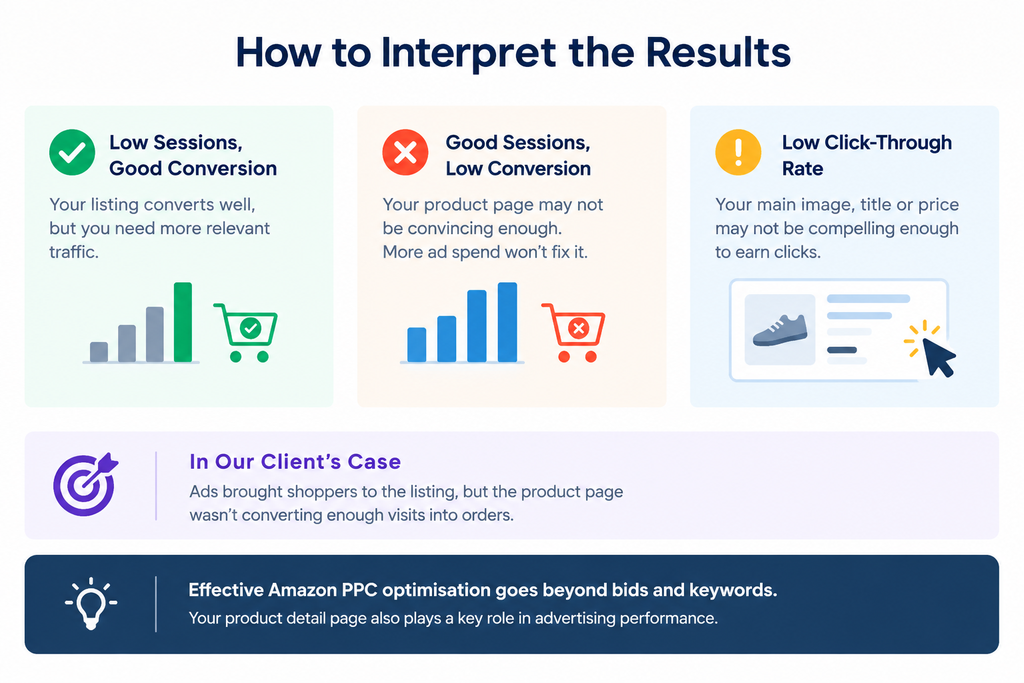
Low sessions with good conversion: Your listing converts visitors effectively, but you may need more relevant traffic.
Good sessions with low conversion: Your product page may not be convincing shoppers to buy. Increasing ad spend without addressing the underlying issue could lead to more costs without a proportional increase in orders.
Low click-through rate: Your main image, product title or price may not be compelling enough to earn clicks in search results.
In our client’s case, the main issue was the second scenario. The ads were bringing shoppers to the listing, but the product page was not converting enough of those visits into orders.
This is why effective Amazon PPC optimisation should not focus exclusively on bids, budgets and keywords. The product detail page also plays a critical role in advertising performance.
Step 2: Improve Your Amazon Product Listing with A+ Content
Once you identify a conversion problem, review the product page before investing more money in advertising.
For our client, we created new Amazon A+ Content with one clear objective: help shoppers understand the product and make purchasing decisions more easily.
A well-structured product listing should communicate value, answer common questions and build confidence. Here are five important areas to address.
1. Communicate the Product’s Value Immediately
Shoppers should understand what a product is, who it is designed for and why it may suit their needs without having to search through the entire page.
Your main image, title and opening product images should communicate the most important information clearly.
Avoid making shoppers work to understand the product. Present its primary benefits early and ensure that the information matches their search intent.
2. Turn Product Features into Customer Benefits
Features explain what a product has. Benefits explain why those features matter to the customer.
For example, “high-density foam” describes a product feature, while “supports your back and lasts for years” communicates a potential customer benefit.
Both types of information matter, but benefits help shoppers understand the practical value of the product.
When writing Amazon product descriptions and A+ Content, connect relevant features with the problems they help solve. Keep claims accurate and supported by the product’s actual specifications.
3. Answer Buying Questions Before Customers Ask
Unanswered questions can create hesitation and prevent a shopper from completing a purchase.
Depending on the product, customers may want to know about:
- Product dimensions and available sizes.
- Delivery times and delivery arrangements.
- Assembly requirements.
- Returns and applicable policies.
- Materials, construction and product quality.
Present this information clearly throughout the product detail page. The goal is to remove unnecessary uncertainty and help shoppers make informed decisions.
4. Build Trust Through Clear Product Information
Customers are more likely to consider a purchase when they understand the brand and feel confident about the product.
Relevant brand stories, guarantees, applicable certifications and genuine product photographs can help establish trust.
However, every claim should be accurate, and certifications or guarantees should only be mentioned when they genuinely apply.
For Amazon sellers, trust-building is not just about presentation. It also depends on consistency between the product images, listing information and actual customer experience.
5. Make Product Comparisons Easier
When a brand offers several sizes, models or variations, shoppers may struggle to determine which option best meets their needs.
A clear comparison chart can help customers evaluate the available options without leaving the product page.
Use simple labels and highlight meaningful differences, such as dimensions, materials and relevant features. This makes the selection process easier and reduces confusion.
Why Listing Optimisation Matters for Furniture and Bed Brands
Product detail page optimisation is particularly important for furniture and bed brands.
Customers cannot physically touch a product when shopping online. They must rely on photographs, dimensions, material descriptions and delivery information to assess whether it meets their needs.
For these products, useful room photographs, accurate measurements, clear material details and transparent delivery information can play an important role in the purchasing decision.
Strong Amazon A+ Content should therefore do more than make a listing look attractive. It should help customers understand the product and feel confident about their choice.
Step 3: Track Amazon Sales Trends Instead of Looking at One Number
A single performance metric rarely tells the whole story.
To evaluate the impact of Amazon listing optimisation, compare sales across different time periods. This helps you understand whether performance is improving, declining or remaining relatively stable.
Consider a real product from one of our UK bed brands.
Amazon product sales performance
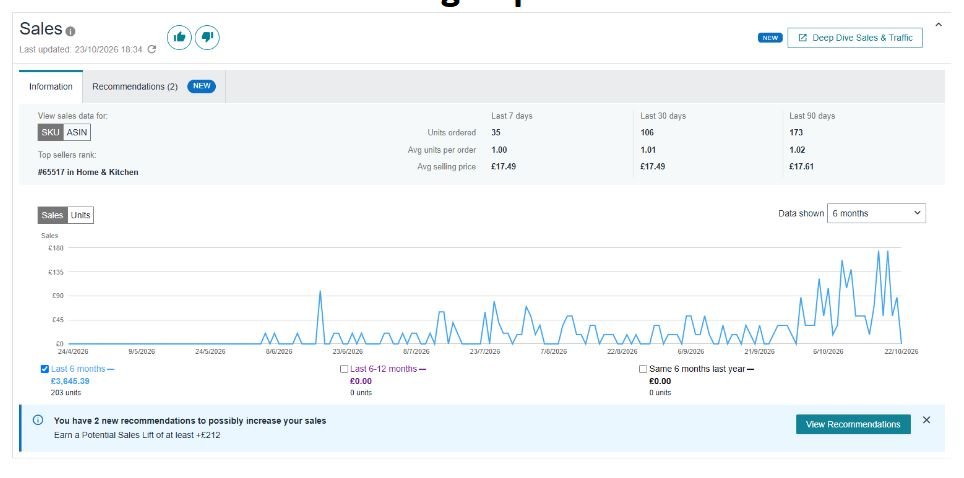
<ins>Last 90 days:</ins> The product sold 173 units.
<ins>Last 30 days:</ins> The product sold 106 units.
The most recent 30-day period accounted for a substantial share of the product’s sales over the full 90-day period. Its performance was much stronger than during the preceding two months.
This is the type of movement worth monitoring after making listing changes.
However, a sales increase alone does not prove that a listing change caused the improvement. Advertising activity, pricing, stock availability, demand and other factors can also influence results.
For a more reliable assessment, compare performance before and after changes and review the other factors that may have affected sales.
How to Use Amazon Sales Data Effectively
A practical monitoring process should include:
- 7-day performance: Identify recent changes that may need investigation.
- 30-day performance: Review the latest monthly sales trend.
- 90-day performance: Understand the broader direction of product sales.
Using these time periods together provides more context than relying on a single daily or monthly figure.
For Amazon sellers, this approach makes it easier to identify meaningful changes and decide where further investigation is needed.
Step 4: Measure Amazon PPC Profitability, Not Just Revenue
Sales revenue is important, but it does not tell you how much money a product generates after advertising and marketplace fees.
A campaign can generate substantial revenue while leaving limited proceeds for the business. That is why Amazon PPC analysis should consider advertising costs and other expenses alongside sales.
Let’s examine the same UK bed brand product over a six-month period.
Six-month product performance
| Performance Metric | Result |
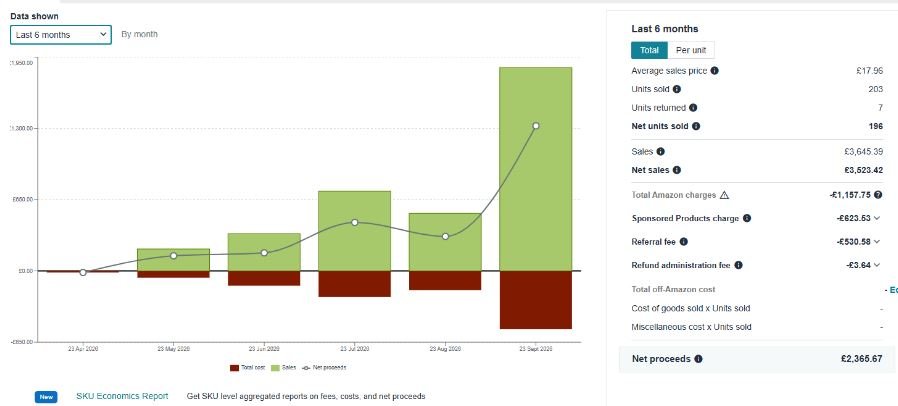
| Sales | £3,645.39 |
| Sponsored Products ad spend | £623.53 |
| Advertising spend as a share of sales | About 17% |
| Net proceeds after Amazon fees and ads | £2,365.67 |
| Cost of goods | Not included in net proceeds |
The product generated £3,645.39 in sales, while £623.53 went towards Sponsored Products advertising. This advertising spend represented approximately 17% of sales.
After Amazon fees and advertising costs, net proceeds were £2,365.67, before deducting the cost of goods.
These figures demonstrate why revenue and profitability should not be treated as the same thing.
Net proceeds are not the same as final business profit. The cost of goods and any other relevant business expenses must also be considered when evaluating the actual financial return.
How Better Conversion Can Support PPC Efficiency
When a listing converts more effectively, the same advertising spend may generate more orders, assuming other factors remain comparable.
This can reduce advertising spend as a share of sales and improve the efficiency of the advertising investment.
For example, if an Amazon listing attracts relevant shoppers but fails to explain the product’s value, increasing the budget may simply bring more visitors to a page that is not doing its job.
Improving the listing first can help sellers make better use of their existing traffic.
This is why Amazon conversion rate optimisation is not just a sales activity. It is also an important part of managing advertising efficiency and protecting profitability.
Step 5: Identify Sudden Drops in Amazon Product Sales
Not every product follows the same sales pattern. Even products with strong overall performance can experience a sudden decline.
Consider a second product from the performance data.
Product sales comparison
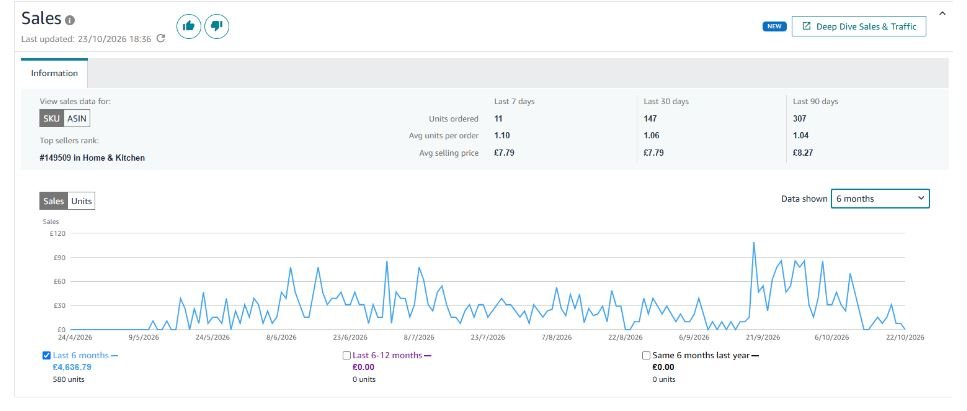
| Period | Units Sold |
| Last 90 days | 307 |
| Last 30 days | 147 |
| Last 7 days | 11 |
The product sold 307 units in 90 days and 147 units in the last 30 days. However, it sold only 11 units in the last 7 days.
That is well below its recent average of around 34 units per week.
This difference deserves investigation. It does not automatically mean that the listing has failed, but it signals that something may have changed.
What to Check When Amazon Sales Decline
When a product’s recent sales fall below its normal trend, review the following areas:
Stock availability: Check whether the product is in stock and available for purchase.
Pricing: Review the current price and any recent changes that could have affected customer demand.
Advertising performance: Examine impressions, clicks, spend and conversions to determine whether campaigns are delivering relevant traffic.
Reviews and ratings: Check whether customer feedback or ratings have changed.
Product listing: Review the main image, title, product information and A+ Content for issues that could affect customer confidence or conversion.
A short weekly review of your 7-day, 30-day and 90-day sales data can help you spot potential problems earlier.
Rather than reacting to every small fluctuation, look for meaningful changes and investigate the possible causes before deciding what action to take.
Step 6: Improve Customer Retention and Encourage Repeat Purchases
Amazon growth does not end when a customer places the first order.
A successful eCommerce strategy should also consider customer retention, repeat purchases and the long-term relationship between shoppers and the brand.
Clear product information and a consistent brand experience can help customers understand what they are buying and build confidence in the business.
However, strong initial sales do not automatically translate into repeat purchases. Retention should be measured separately.
What the Customer Data Reveals
The following figures come from another brand performance report.
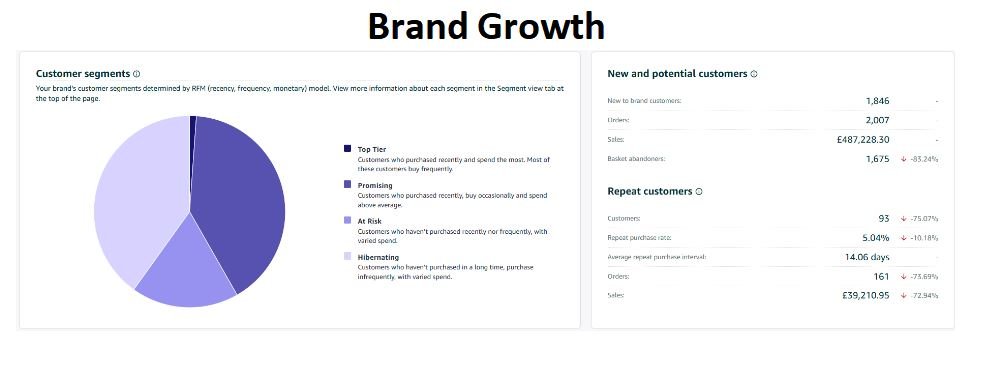
| Customer Metric | Result |
| New-to-brand customers | 1,846 |
| Orders placed by new-to-brand customers | 2,007 |
| Sales value of those orders | £487,228.30 |
| Repeat customers | 93 |
| Repeat purchase rate | 5.04% |
The brand reached 1,846 new-to-brand customers, who placed 2,007 orders worth £487,228.30.
However, repeat customers totalled 93, with a repeat purchase rate of 5.04%. Both repeat customer figures were down compared with the previous period.
This indicates an opportunity to investigate customer retention.
The next step is to understand why repeat purchasing has declined. The answer may depend on the product category, normal repurchase cycle, customer experience and other factors.
A stronger brand story, clear product pages and appropriate follow-up can help support customer relationships. The impact should be measured over time rather than assumed.
For sellers working towards sustainable eCommerce growth, customer acquisition and customer retention deserve separate attention.
Before Increasing Your Amazon Advertising Budget, Review Your Listing
When Amazon sales slow down, increasing PPC spend may seem like the quickest solution. But before making that decision, take a fresh look at the product page.
Ask yourself one simple question:
If I landed on this product page today, would I buy?
Then review the following checklist.
Does the main image stand out in Amazon search results?
Does the product title clearly explain what the product is?
Do the first five images answer the customer’s main questions?
Does the A+ Content communicate benefits rather than only features?
Are product sizes, delivery details and returns clearly explained?
Are the reviews and ratings strong enough to support customer confidence?
If you answer “no” to two or more questions, review the listing before increasing your advertising budget.
This checklist is a practical starting point, not a guarantee of improved sales. Prioritise the issues that are most relevant to your customers and validate the results using performance data.
A Practical Amazon Listing Optimisation Strategy
The examples above highlight a straightforward principle: advertising, listing quality and profitability should be evaluated together.
For a more structured approach, follow these steps:
1. Diagnose the problem. Review sessions, click-through rate, unit session percentage and advertising conversion rate to determine whether the main issue involves traffic or conversion.
2. Improve the product page. Strengthen the main images, title, product information and A+ Content to address customer questions and communicate value.
3. Monitor performance over time. Compare 7-day, 30-day and 90-day sales figures to identify meaningful changes.
4. Review advertising efficiency. Compare Sponsored Products spend with sales and account for Amazon fees and product costs when assessing profitability.
5. Investigate unexpected declines. Check stock, price, advertising performance, reviews and listing quality when sales fall below their recent trend.
6. Evaluate customer retention. Track repeat customers and repeat purchase rate separately from new-to-brand customer acquisition.
This process helps Amazon sellers make decisions based on evidence instead of increasing advertising spend
FAQs
Amazon listing optimisation is the process of improving a product’s title, images, descriptions, product information and A+ Content to help relevant shoppers understand the product and make informed purchasing decisions.
Review sessions and unit session percentage in Seller Central Business Reports, alongside click-through rate and ad conversion rate in Amazon Ads. Good traffic combined with weak conversion can indicate that the product page needs improvement.
A+ Content can help explain product benefits, answer customer questions, present brand information and compare product options. Its actual impact should be measured against relevant performance data rather than assumed.
Not automatically. First investigate traffic, conversion, stock availability, pricing, advertising performance, reviews and listing quality. Increasing the budget before identifying the problem may add costs without addressing the cause.
Sales revenue does not account for advertising costs, Amazon fees or the cost of goods. Reviewing these expenses provides a more useful picture of product economics and helps sellers make better-informed advertising decisions.
Conclusion:
Amazon PPC can bring shoppers to your product page, but the listing must help them understand the product, evaluate its value and make a purchasing decision.
Our examples show why sellers should look beyond revenue and advertising metrics alone. Listing conversion, sales trends, advertising costs and repeat customer behaviour all contribute to a more complete picture of eCommerce performance.
Before investing more in Amazon advertising, identify where the real problem lies. If traffic is low, work on attracting relevant shoppers. If traffic is already strong but conversions are weak, focus on improving the product page.
