

A few years ago, ranking on page one of Google was the finish line. That’s no longer true. Someone searching “best budget mattresses” today might never see a list of blue links at all — they’ll get a direct answer from ChatGPT, Perplexity, or Google’s AI Overviews, stitched together from a handful of sources the AI decided were worth trusting.
That’s the real shift behind how to get blog posts cited by AI search engines: it isn’t a new trick layered on top of old SEO. It’s a new audience — the AI model itself — reading your content before a human ever does, and deciding whether it’s worth repeating.
Getting cited consistently isn’t about stuffing in the right phrase. It comes down to writing things that are genuinely useful, structuring them so they’re easy to lift out of context, and building enough credibility that an AI system has a reason to trust your page over ten others saying something similar.
What Makes AI Search Different From Traditional Search?
Traditional search hands you a list of pages and lets you decide which one to open. AI search engines skip that step — they read the question, pull from several sources at once, and hand back a single synthesized answer.
That changes the goal. A page can sit at position one on Google and still be completely invisible inside an AI-generated answer, because ranking and being cited are two different mechanics. This is why AI search visibility now sits alongside traditional rankings as something worth tracking on its own.
AI search optimization grew out of this gap. Instead of writing purely to satisfy a ranking algorithm, publishers now think about whether a machine reading the page can quickly identify what it’s about, what evidence backs it up, and what direct answer it’s offering.
Why AI Citations Matter
AI citations work like a new front door to your site. When a platform pulls a line from your article into an AI-generated answers experience, the person reading that answer sees your name attached to it — and some of them click through.
That’s why so many businesses are watching AI search citations closely and trying to reverse-engineer which pages get pulled in and which get skipped, even when they cover the same ground.
The mistake most people make here is treating this like keyword density 2.0 — repeating a phrase until an algorithm supposedly notices it. That’s not what earns a citation. What earns one is citation-worthy content: something that actually answers the question, adds a detail nobody else included, and states things clearly enough that an AI system can lift them without misquoting you.
How Do AI Search Engines Select Sources?
The honest answer to how does AI search choose sources is: nobody outside these companies has the full formula, and it changes.
What we can observe is the pattern. Relevance, depth, clarity, how recently a page was updated, whether it names real entities (people, brands, places), how many other credible pages link to it, and general site trustworthiness all seem to play a role in whether a page becomes source material for an answer.
That’s also the honest answer to why does AI cite certain websites and not others covering an identical topic — it usually isn’t one factor doing the heavy lifting. A page with strong writing but a thin, unknown domain can lose out to a page that’s slightly less polished but sits on a site the model already “trusts” from other content. Understanding how do AI search engines select sources means looking at the whole picture of a website, not chasing one tactic in isolation.
Create Content That AI Can Understand
AI content optimization really just means: make it obvious, fast. Descriptive headings, short paragraphs, a direct answer near the top of a section instead of three sentences of throat-clearing before it, and lists or tables where they genuinely help.
This is also what how to make content easy for AI to understand looks like in practice — plain language, one idea per paragraph, and terms used the same way throughout the piece instead of switching between three synonyms for the same concept.
None of this means writing for a robot instead of a person. AI-friendly content and reader-friendly content are the same content, most of the time — a machine just rewards the clarity a tired human reader was always going to appreciate anyway.
Match Content With Real Search Questions
Good content strategy starts with the actual question someone typed, not the topic you feel like writing about. A publisher digging into how to get your blog cited by AI search engines should map out what a reader asks before that question, during it, and after — each of those can become its own heading, FAQ entry, or even a separate article.
The broader version of this, how to get website content cited by AI, isn’t limited to blogs — it applies just as much to product pages, documentation, and long-form guides.
Related searches worth knowing about include how to make blog posts appear in AI search results, how to optimize blog posts for AI search engines, and how to write blog posts AI search engines cite. All of them point at the same underlying need: content built to be a useful source, not just a page that happens to rank.
Make Blog Posts Citation-Worthy
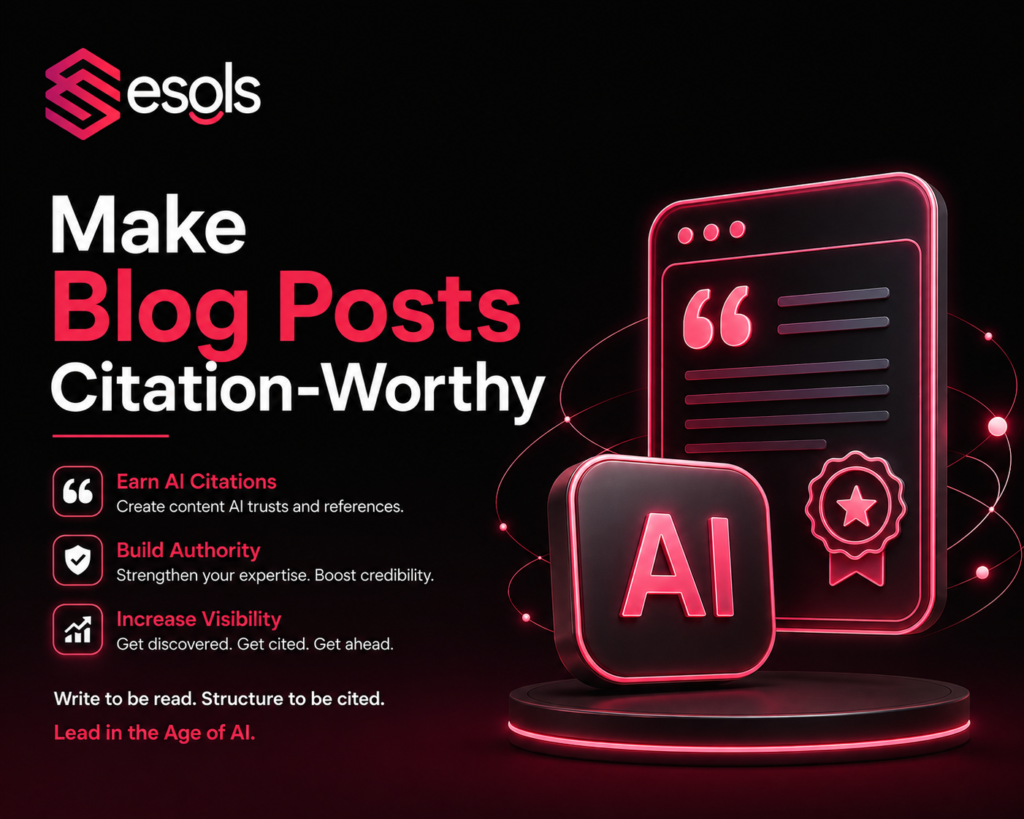
How to make content citation worthy for AI search comes down to one test: does this page contain something worth repeating?
A citation-worthy post answers its main question directly and backs it up with enough detail that the claim actually holds up. A paragraph that restates the same three sentences you’d find on the first five Google results for that topic isn’t adding anything — and an AI model has no reason to pick your version of that sentence over anyone else’s.
What does add something: a real example instead of a hypothetical one, a first-hand observation, a number you actually measured, or an explanation of a nuance most articles skip. That’s the difference between how to create citation-worthy blog posts and simply hitting a word count. For instance, instead of writing “internal links help SEO,” a stronger version names the actual improvement observed after adding them — even a rough, honestly-labeled internal test result beats a generic claim.
Strengthen Topical Authority
One article can answer one question. A cluster of connected articles proves you actually know the subject — and that’s what topical authority for AI search is measuring.
A site built around AI search, for example, might publish one central guide (like this one) alongside dedicated pieces on citation tracking, entity structuring, technical implementation, and platform-specific tactics. Together, they read as a body of knowledge instead of a pile of disconnected posts each chasing a different keyword.
Semantic SEO for AI search pushes this further — instead of treating “AI citations” and “AI search visibility” as two unrelated targets, you write about them as parts of the same system, the way an expert would actually explain the topic out loud.
Use Entities and Clear Relationships
Search systems increasingly try to identify what a page is actually about — the specific people, brands, tools, and concepts it discusses — not just the words on it. That’s entity SEO for AI search.
Knowing how to use entities in content for AI search means naming things precisely (say “Google AI Overviews,” not just “AI search results”) wherever it’s genuinely relevant, rather than sprinkling brand names in to game visibility. Precision here does double duty: it helps readers and it gives the model something concrete to anchor the content to.
Follow Strong E-E-A-T Principles
E-E-A-T for AI search — experience, expertise, authoritativeness, and trustworthiness — matters more when a model is choosing which source to lean on for an answer someone might actually act on.
In practice, that means naming a real author with relevant background, describing the experience behind the claims (did you test this yourself, or are you summarizing?), linking to credible sources, and correcting mistakes instead of leaving them up. For anything research-heavy, pulling from authoritative sources for AI search — government data, established research bodies, primary documentation — strengthens the piece far more than another blog citing another blog.
Publish Original Research
Nothing differentiates a page faster than information nobody else has. Original research for AI citations can be as involved as a survey or as simple as your own before/after data from a single client project.
If you have even a small, honestly-reported dataset — say, tracking how many of your own articles got cited across three AI platforms over a quarter — that single data point gives other writers and AI systems a real reason to reference your page instead of paraphrasing someone else’s paraphrase.
Structure Blog Posts for AI Search
Formatting isn’t decoration — it’s what lets both a skimming reader and a parsing model find the actual answer fast. That’s how to structure blog posts for AI search in one sentence.
A reliable blog structure for AI search engines generally includes:
- A short introduction that states the point up front
- A direct answer to the main question, early
- Clearly labeled H2/H3 sections, each with one job
- Supporting detail and examples underneath
- Real evidence or data where it exists
- A tight FAQ section
- A short conclusion, not a re-summary of everything above
Optimize Headings and FAQs
A heading should tell you what’s under it without needing to read the paragraph. That’s the whole idea behind how to optimize headings for AI search — write them as the actual question a reader has, not a vague label.
FAQs work the same way. How to optimize FAQs for AI search means answering real, distinct questions — not restating the same keyword five different ways to pad the section. A well-built FAQ picks up the smaller questions the main article didn’t have room for and answers each one in two or three sentences, no more.
Use Internal Links Strategically
How internal links help AI search goes beyond the old “pass link equity” logic. Internal links tell a model how your topics relate to each other — that this citation article connects to a deeper piece on structured data, which connects to another on measuring visibility.
A well-linked site reads as a coherent knowledge base. A site with isolated, unlinked posts reads as a collection of one-off articles with no clear expertise behind them.
Build Authority Beyond the Website
External signals still count. The link between backlinks and AI search citations isn’t a clean one-to-one formula, but reputable sites linking to you is still one of the clearest trust signals available to any system trying to judge credibility.
Brand mentions and AI search visibility work in a similar, quieter way — even unlinked mentions of your name across trustworthy sites build up recognition over time. Neither of these should be chased directly; they’re the byproduct of doing work worth talking about — real research, real partnerships, real coverage.
Keep Content Fresh and Accurate
Content freshness and AI search matters more in fast-moving areas like this one, where platform behavior can shift within months.
Freshness doesn’t mean touching an article just to bump the date. It means going back in when something material changes — a platform updates how it cites sources, a stat goes stale, a section no longer answers what people are actually asking. A quarterly review catches most of this before it becomes a real accuracy problem.
Optimize for Major AI Search Platforms

Each platform behaves a little differently, so it’s worth knowing where the differences actually matter.
ChatGPT Search
How to get cited in ChatGPT search starts with the same fundamentals as everything above — reliable, accessible, directly useful content — rather than platform-specific tricks. ChatGPT Search optimization leans on clear information architecture, strong topical relevance, and content that answers the real question without padding.
Google AI Overviews
How to get cited in Google AI Overviews connects closely to traditional SEO strength. Google AI Overviews synthesizes answers while linking out to supporting sources, so solid technical SEO, clear answers, and established authority all still carry weight. Treat AI Overviews SEO as an extension of your existing SEO work, not a separate discipline running in parallel.
Perplexity AI
Perplexity AI puts source citations front and center in its interface, arguably more visibly than any other major platform. A solid Perplexity SEO approach prioritizes well-organized, clearly authoritative content that satisfies the query directly, since citations here are so visible to the end user.
Microsoft Copilot
Microsoft Copilot search is another environment where strong web content can feed into generated answers. Bing AI search optimization benefits from the same base — solid technical SEO, genuine authority, and content that’s easy to parse.
Google AI Search
A broader Google AI search optimization strategy combines established SEO fundamentals with content built specifically to answer questions clearly and demonstrate real expertise, rather than treating AI visibility as a bolt-on tactic.
Understand GEO and AEO
Generative engine optimization is the umbrella term for making content easier for generative systems to find, understand, and represent accurately.
A working generative engine optimization strategy usually combines strong topical coverage, original information, clear direct answers, credible sourcing, clean structure, and basic technical accessibility. The generative engine optimization best practices worth following all point the same direction: focus on usefulness, not on reverse-engineering a specific model’s quirks.
Answer engine optimization is a closely related idea focused specifically on content built to directly answer discrete questions. Both sit under the wider goal of generative search optimization — making genuinely useful information easy for modern systems to surface.
FAQs
Create original, well-structured content that answers real user questions with clear, accurate, and trustworthy information.
No. AI selects sources it considers relevant, reliable, and useful for the specific query.
Yes. Regularly refreshing content with accurate information and new insights can improve its citation potential.
Clear expertise, credible sources, factual accuracy, and a logical page structure all help build trust.
Not necessarily. The strongest content strategy aims to earn both traditional search visibility and AI citations.
Final Thoughts
Search is moving past the ranked list and toward a world of synthesized, conversational answers with citations attached. For publishers, the target isn’t one more position on a results page — it’s becoming the source a system trusts enough to quote.
Anyone working through how to make AI cite your website should start with the fundamentals covered here: real usefulness, clean structure, genuine authority, original information, credible sourcing, basic technical accessibility, and the discipline to keep revisiting the work. Get those right, and the citations tend to follow.
