
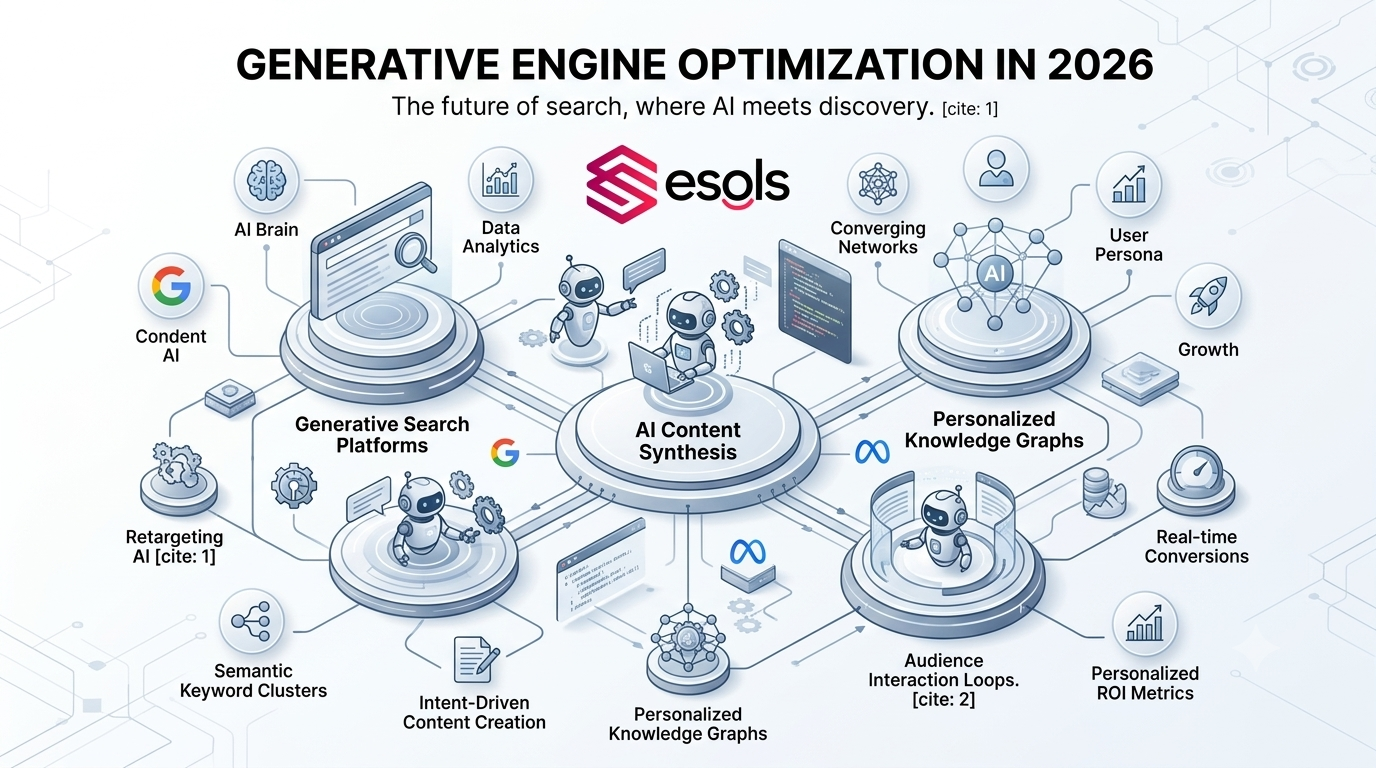
What Is GEO? The Complete Guide to Generative Engine Optimization in 2026
Imagine you run a taxi company in Chalfont. A potential customer opens ChatGPT and types: ‘What is the best taxi service near Chalfont for airport transfers?’ ChatGPT generates a confident answer — and your business is not mentioned anywhere in it.
That is the problem GEO solves.
Generative Engine Optimization — or GEO — is the discipline of making your business, content, and brand visible inside AI-generated answers. Not just on Google. Not just on Bing. Inside ChatGPT, Google AI Overviews, Gemini, Perplexity, and every AI tool that answers questions on behalf of your potential customers.
In 2026, this is no longer a futuristic concept. It is where your customers are already going. And most businesses are not prepared.
What Is Generative Engine Optimization (GEO)?
Generative Engine Optimization is the practice of structuring your content, website, and online presence so that AI language models — like ChatGPT, Google Gemini, Claude, and Perplexity — choose to cite, reference, and recommend your brand when generating answers for users.
Traditional SEO focuses on ranking in a list of blue links on Google. GEO focuses on being the source AI engines pull from when they write the answer directly.
Think of it this way: SEO gets you on the menu. GEO gets you in the meal.
GEO vs SEO vs AEO — What Is the Difference?
You may also hear the terms Answer Engine Optimization (AEO) and AI SEO. They all describe the same goal — getting cited by AI. The industry has not fully settled on one name yet, but GEO is the most widely used in 2026. Here is how they compare:
| Traditional SEO | AEO | GEO | |
| Goal | Rank in Google results | Appear in featured snippets | Get cited by AI engines |
| Platform | Google, Bing | ChatGPT, Gemini, Perplexity, Claude | |
| Format | Blue links | Boxes & direct answers | Conversational AI responses |
| Key signal | Backlinks & keywords | Structured data | Topical authority & citations |
| Status 2026 | Still relevant | Partially merged into GEO | Essential — fastest growing |
Why GEO Is the Most Important Marketing Shift of 2026
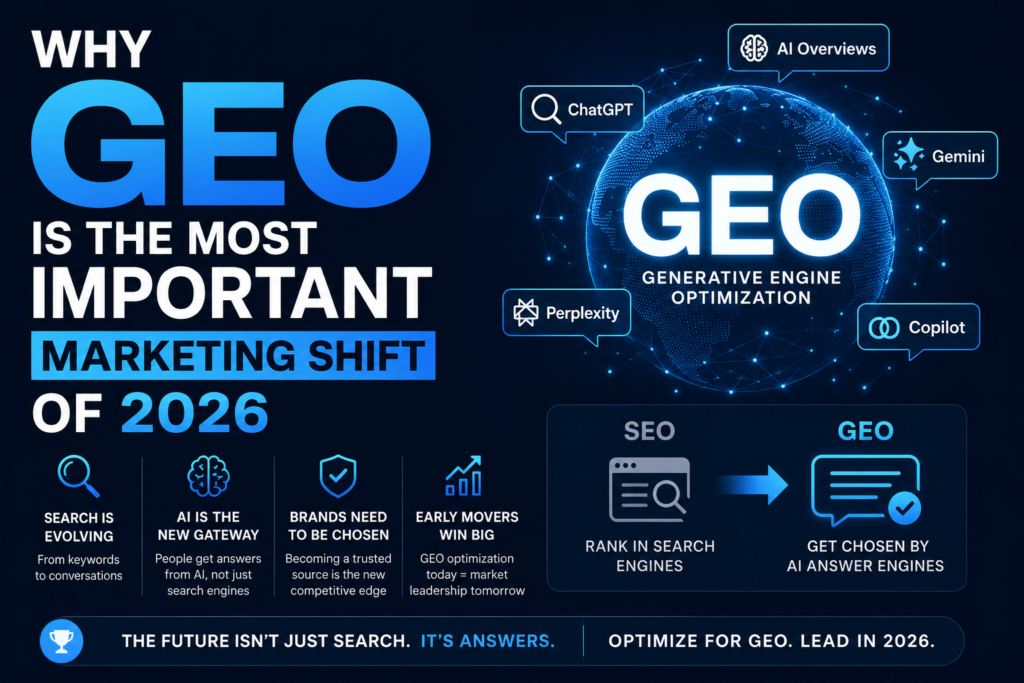
The numbers tell a story that is hard to ignore. We are not talking about a small shift at the margins. This is a structural transformation in how people find information and make purchasing decisions.
The Data Is Clear
| Statistic | Source |
| Traditional search volume projected to drop 25% in 2026 | Gartner Research |
| ChatGPT serves over 800 million users every week | Anthropic / OpenAI Reports, 2026 |
| Google AI Overviews now reach 2 billion+ monthly users | Google Official Data, 2026 |
| AI-referred sessions jumped 527% year-over-year | Previsible AI Traffic Report, 2025 |
| 58.5% of Google searches now end without any click | Seer Interactive Research |
| When AI Overviews appear, organic CTR drops by 61% | Seer Interactive Research |
| GEO overlap with top Google results has dropped from 70% to below 20% | Brandlight Research |
| Early GEO adopters report 32% of leads now come from AI search | Multiple Agency Case Studies, 2026 |
The conclusion is unavoidable. Your customers are already using AI to research, compare, and decide. If your brand is not in those AI answers, you are losing sales to competitors who are.
How Generative Engine Optimization Actually Works
Understanding GEO starts with understanding how AI search engines behave differently from traditional search engines.
When someone types a query into Google, it matches keywords to pages and returns a ranked list. When someone asks ChatGPT or Perplexity a question, the AI does something very different. It generates a synthesized answer by pulling together information from multiple trusted sources — and it decides which sources to cite based on a completely different set of signals.
What AI Engines Look For When Deciding What to Cite
- Does your website deeply cover this subject area? AI engines prefer sources that are the definitive resource on a topic, not generalist sites that mention it briefly.: Topical Authority
- Is your content written in clear, factual language that answers questions directly? AI models prefer well-structured content with clear statements, not vague prose.: Content Structure
- A Princeton/Georgia Tech study found that including quotations increases AI citation likelihood by 41%, statistics by 32%, and citations by 30%.: Statistics and Citations
- The more your brand is mentioned across trusted websites, forums, reviews, and news sources, the more AI models learn to associate you with your area of expertise.: Brand Mentions Across the Web
- AI crawlers need to be able to read your content. Fast load times, clean architecture, and mobile optimisation all improve your chances of being cited.: Technical Accessibility
- AI engines weight recent content more heavily. A guide published in 2024 with no updates will lose ground to a 2026 article on the same topic.: Recency
Real-World Examples of GEO in Action
Example 1 — IKEA and AI-Powered Discovery
IKEA’s Kreativ AI tool lets users scan their rooms and swap existing furniture for IKEA products. By embedding this AI tool into their product experience, IKEA created a format that AI engines naturally cite when users ask about furniture planning tools. The result: brand mentions in AI responses surged without any traditional keyword targeting.
Example 2 — B2B SaaS and Conversational Research
Research shows that B2B buyers increasingly ask AI systems detailed evaluation questions — such as ‘what is the best marketing automation tool for a 20-person team?’ — before they ever visit a vendor’s website. Companies that create detailed category-definition content, comparison articles, and FAQ-style resources are being cited in these answers. Companies that do not are invisible at the most critical stage of the buying journey.
Example 3 — Local Business Visibility
Even local service businesses are affected. A taxi company, restaurant, or accountancy firm with strong review signals, consistent business information across directories, and service-specific content on their website is far more likely to appear in AI responses when users ask for local recommendations. Chalfont Taxis, for example, already has an AI Visibility Score of 30 — above average for local businesses — largely because it has been mentioned organically across multiple platforms. With deliberate GEO, that visibility could be significantly extended.
Your Step-by-Step GEO Strategy for 2026
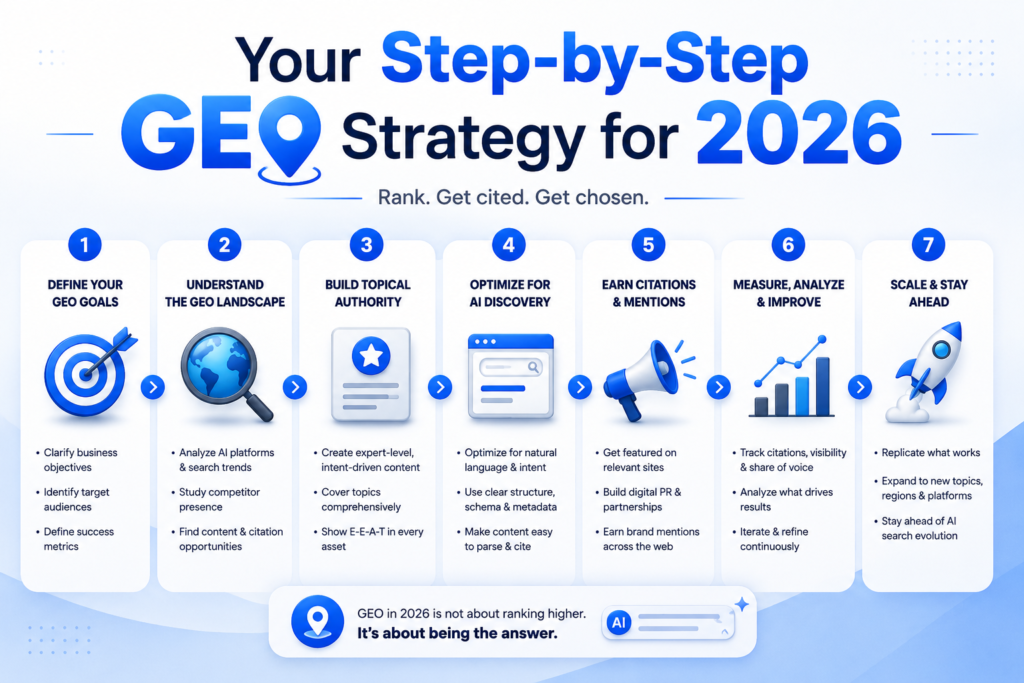
Implementing GEO does not mean abandoning everything you know about SEO. A solid SEO foundation actually helps GEO performance — AI engines use traditional SEO signals as quality indicators. What GEO adds is a set of additional practices designed specifically for how AI models evaluate and select sources.
Step 1 — Build Deep Topical Authority
AI engines do not trust generalists. They cite specialists. Your website needs to demonstrate that it is the definitive resource on your core topic — not just a page that mentions it.
- Create pillar pages that comprehensively cover your main topic area
- Build content clusters — supporting articles that link back to your pillar pages
- Cover your topic from every angle: what it is, how it works, comparisons, FAQs, case studies
- Avoid spreading too thin — dominate a niche before expanding
Step 2 — Write for Machines and Humans
AI models read your content in a specific way. They are looking for clear, factual statements they can extract and present in an answer. Write with this in mind:
- Use direct, confident statements — avoid vague language like ‘it could be’ or ‘in some cases’
- Include statistics, research findings, and original data wherever possible
- Use FAQ sections — these match directly with how users phrase AI queries
- Structure with clear H2 and H3 headings — AI engines use these to understand content hierarchy
- Answer questions directly at the start of each section, then elaborate
Step 3 — Build Your Brand’s Digital Footprint
AI models learn about your brand from signals across the entire internet — not just your website. The more trusted places your brand is mentioned, the more credible it becomes to AI systems.
- Get featured in industry publications and news sites
- Build and maintain your Google Business Profile with consistent, detailed information
- Encourage reviews on Google, Trustpilot, and industry-specific review sites
- Be active in relevant online communities and forums — Reddit and YouTube are among the most-cited sources in AI Overviews
- Create and maintain profiles on LinkedIn, industry directories, and local citation sites
Step 4 — Add Technical GEO Signals
Several technical additions specifically help AI engines understand and trust your site:
- Add an llms.txt file — a plain-text file in your root directory that tells AI crawlers what content is available and what to prioritise
- Implement structured data (schema markup) — LocalBusiness, FAQPage, HowTo, and Article schemas all increase AI citation likelihood
- Update your robots.txt to specifically allow AI crawlers (such as GPTBot, PerplexityBot, and GoogleOther)
- Ensure fast load times and clean site architecture — AI engines reward crawlable, accessible sites
Step 5 — Measure GEO Performance
Traditional SEO metrics do not fully capture GEO performance. You need to track:
- Branded search volume trends — growth indicates AI users are discovering you and then searching for you directly
- Direct traffic increases — AI-referred users often visit directly later rather than clicking through immediately
- AI mention tracking — tools like Brandlight, Semrush AI Toolkit, and Frase now offer AI citation monitoring
- Conversational query tracking in Google Search Console — look for question-based queries you are beginning to rank for
Common GEO Mistakes Businesses Make in 2026
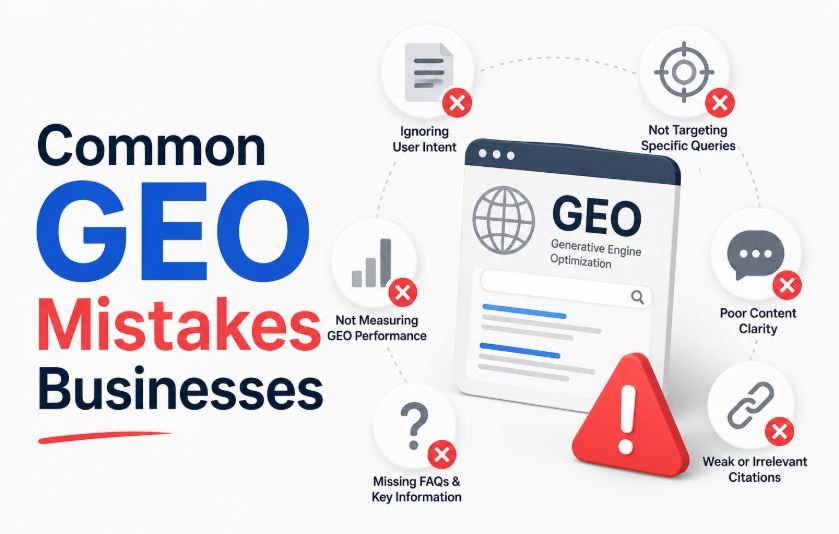
- Treating GEO as a replacement for SEO — they work together. Technical SEO is still the foundation AI engines build on.
- Publishing thin, AI-generated content at scale — AI engines are now very effective at filtering out low-quality, repetitive content.
- Ignoring brand mentions off your own site — GEO is about your entire digital presence, not just your website.
- Optimising for keywords but not for questions — AI search is conversational, not keyword-based.
- Not updating existing content — AI engines weight recency heavily. Old articles lose ground fast.
- Blocking AI crawlers — check your robots.txt. Some sites accidentally block GPTBot and similar crawlers.
How Long Does GEO Take to Show Results?
GEO results follow a predictable timeline when implemented correctly:
| Timeframe | What Happens |
| Weeks 1-4 | Technical optimisations complete (schema, llms.txt, structured content). Foundation is in place. |
| Weeks 2-4 | Technical fixes (schema, llms.txt, structured data) take 2-4 weeks to show effects. |
| Weeks 4-12 | First AI citations begin appearing. Branded search volume starts to increase. |
| Months 3-6 | Consistent AI visibility established. Direct traffic and assisted conversions become measurable. |
| Months 6-12 | Citation authority compounds. GEO becomes a predictable, reliable traffic and lead source. |
| Ongoing | GEO is an investment that strengthens over time. Early movers build a compounding advantage. |
Your GEO Action Plan — Where to Start This Week
GEO can feel overwhelming, but the starting point is straightforward. Here are the five actions you can take this week that will have the highest impact:
- Audit your existing content. Identify your top 5 pages. Do they answer questions directly? Do they include statistics? Do they use clear H2/H3 structure? Update them if not.
- Add FAQ schema to your homepage and key service pages. This is one of the fastest wins in GEO — it directly feeds AI Overview and conversational search formats.
- Create or update your llms.txt file. Place it in your root directory and list your key content pages. This is a 30-minute technical task with a disproportionate impact.
- Check your robots.txt. Make sure you are not blocking GPTBot (ChatGPT), PerplexityBot, or GoogleOther. Many businesses accidentally block these crawlers.
- Identify 3 topic clusters you want to own. Plan one pillar page and four supporting articles for each. This is your 90-day content roadmap for GEO authority.
Conclusion: GEO Is Not the Future — It Is Right Now
The shift to AI search is not coming. It has arrived. With over 800 million people using ChatGPT every week, 2 billion monthly users seeing Google AI Overviews, and traditional search volume in measurable decline, the question is no longer whether to invest in GEO.
The question is whether you will be cited when your customers ask AI for recommendations in your industry.
The good news is that most businesses have not started yet. The window for early-mover advantage is open right now. The businesses that build topical authority, optimise their content for AI citation, and grow their digital brand footprint in 2026 will dominate AI search for years to come.
GEO is the most important discipline in digital marketing today. If your strategy does not include it, your competitors’ will.
