
A well-planned landing page funnel can turn paid advertising and other traffic sources into qualified leads, appointments, and sales. Instead of sending every visitor to a general homepage, businesses can guide prospects through a focused journey designed around one specific goal.
A strong landing page funnel setup connects the advertisement, landing page, offer, lead capture process, follow-up, tracking, and conversion stage. When these elements work together, businesses have a clearer path from the first click to the final conversion.
This guide explains how a business can build a high-performing funnel, what elements matter most, and how the process can be adapted for Google Ads, Meta Ads, service businesses, local companies, high-ticket offers, and e-commerce.
Table of contents
- What Is a Landing Page Funnel?
- How to Build a High-Converting Landing Page Funnel
- Landing Page Structure for a Sales Funnel
- Landing Page Copywriting for Funnel Conversions
- Creating High-Converting Landing Page Headlines
- Landing Page CTA Optimization
- Lead Generation Landing Page Funnel
- Landing Page Funnel for Google Ads
- Landing Page Funnel for Meta Ads
- Paid Traffic Landing Page Optimization
- Landing Page Conversion Rate Optimization
- Landing Page A/B Testing Strategies
- Mobile Landing Page Optimization
- Landing Page Speed Optimization
- Landing Page Trust Signals That Increase Conversions
- Using Social Proof in Sales Funnels
- Lead Capture Forms for Landing Pages
- Landing Page Form Optimization
- Thank You Page Funnel Strategy
- Landing Page to Appointment Booking Funnel
- Landing Page to CRM Funnel Integration
- Landing Page Conversion Tracking Setup
- Google Ads Conversion Tracking for Landing Pages
- Meta Pixel Tracking for Landing Page Funnels
- Landing Page Retargeting Funnel Setup
- Cold Traffic Landing Page Funnel Strategy
- High-Ticket Service Landing Page Funnel
- E-commerce Landing Page Sales Funnel
- Landing Page Funnel for Local Businesses
- Landing Page Funnel Optimization: From Click to Conversion
- Complete Landing Page Funnel Setup Checklist
- Final Thoughts
What Is a Landing Page Funnel?
A landing page funnel is a structured journey that moves a potential customer from an initial interaction toward a specific conversion. The visitor may arrive through an advertisement, organic search, social media, email, or another marketing channel.
Unlike a general website, a focused funnel typically removes unnecessary distractions and directs visitors toward one primary action.
A typical sales funnel may include:
- Advertisement or traffic source
- Dedicated landing page
- Offer and supporting information
- Lead capture or purchase action
- Thank-you page
- Follow-up or automation
- Retargeting and additional conversion opportunities
The exact structure depends on the business model, audience, offer, and desired outcome.
How to Build a High-Converting Landing Page Funnel
Businesses wondering how to build a landing page funnel should begin with the conversion goal rather than the page design.
For example, a service company may want visitors to request a quote, while a consultant may want them to book a consultation. An e-commerce company may want visitors to purchase a product.
The funnel should therefore be built around a single primary objective.
A practical process includes:
- Identifying the target audience
- Defining the offer
- Selecting the traffic source
- Creating the landing page
- Developing persuasive messaging
- Adding an appropriate conversion mechanism
- Connecting tracking and analytics
- Creating follow-up sequences
- Testing and improving performance
This approach creates a conversion funnel in which every stage has a clear purpose.
Landing Page Structure for a Sales Funnel
The landing page structure should make it easy for visitors to understand what is being offered and why they should take action.
A typical funnel landing page can contain:
1. Headline
The headline should immediately communicate the primary benefit or solution.
2. Supporting Message
A short section can explain the problem, opportunity, or value behind the offer.
3. Benefits
Instead of focusing exclusively on features, the page can explain how the offer helps the customer.
4. Proof
Testimonials, reviews, results, certifications, or case studies can reduce uncertainty.
5. Offer
The visitor should understand exactly what is being provided and what makes the offer worthwhile.
6. Call to Action
The page should clearly communicate what the visitor should do next.
7. Conversion Element
Depending on the funnel, this could be a form, booking system, checkout, phone number, or another mechanism.
A simple page layout is often easier for visitors to navigate than a page containing excessive information and competing calls to action.
Landing Page Copywriting for Funnel Conversions
Effective landing page copywriting connects the visitor’s needs with the offer. The messaging should be relevant to the audience that arrives on the page.
Strong conversion copy generally answers questions such as:
- What problem does the business solve?
- Who is the service or product for?
- What benefits can the customer expect?
- Why should the customer trust the business?
- What should the customer do next?
For commercial campaigns, sales copy should remain specific and focused instead of making vague promises.
The message should also match the advertisement that brought the visitor to the page. A disconnect between the ad and landing page can create confusion and reduce the likelihood of conversion.
Creating High-Converting Landing Page Headlines
The headline is one of the first elements visitors see, making landing page headlines an important part of the funnel.
Effective headline optimization focuses on clarity and relevance. The headline should quickly establish what the visitor can gain from continuing.
For paid campaigns, ad headlines and landing page headlines should also communicate a consistent message. If an advertisement promotes a particular service or offer, the landing page should reinforce that same promise.
Landing Page CTA Optimization
A strong landing page CTA gives visitors a clear next step.
The call to action may encourage visitors to:
- Request a quote
- Book an appointment
- Start a free trial
- Download a resource
- Contact the business
- Purchase a product
Effective CTA optimization considers wording, placement, visibility, and the amount of friction involved in taking action.
Lead Generation Landing Page Funnel
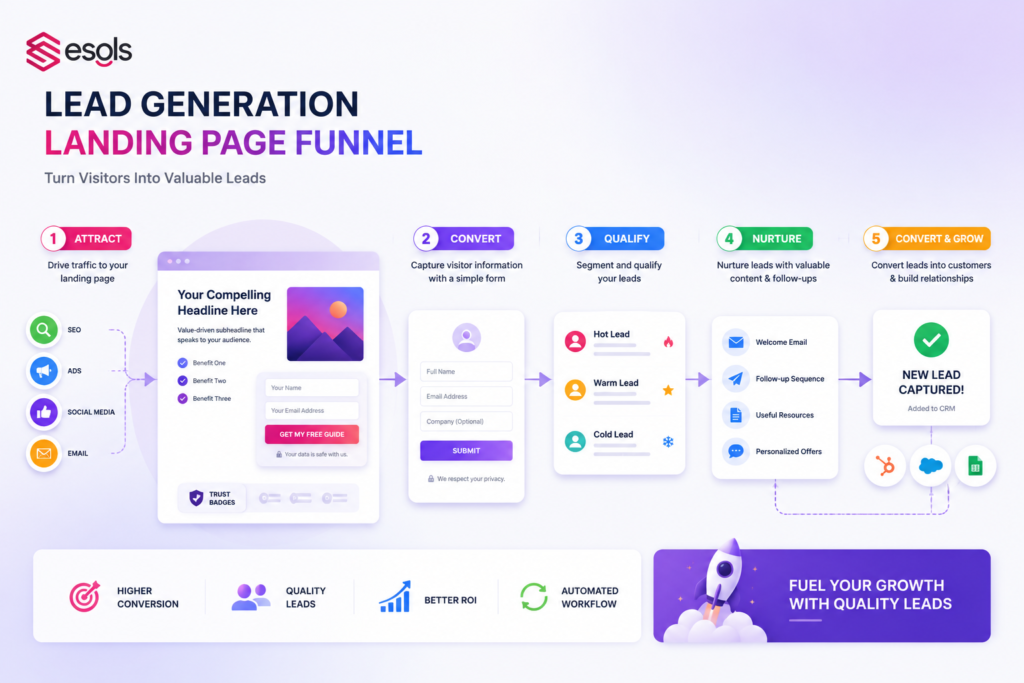
A lead generation landing page is designed to collect information from potential customers rather than immediately complete a sale.
A well-designed lead capture funnel can use a form to collect details such as a name, email address, phone number, company information, or service requirements.
The information collected should be appropriate for the next stage of the sales process. Asking for unnecessary information can create friction, particularly when the visitor is still learning about the business.
A lead funnel can then connect the captured prospect to sales follow-up, email automation, appointment scheduling, or CRM processes.
Landing Page Funnel for Google Ads
A Google Ads landing page should closely align with the searcher’s intent.
Someone searching for a specific service generally expects to see information that directly relates to that service. Sending the visitor to a highly relevant page can create a more consistent experience from search result to conversion.
A Google Ads funnel may therefore follow this path:
Search query → Google advertisement → relevant landing page → lead form → thank-you page → follow-up
A dedicated PPC landing page can also make campaign performance easier to evaluate because the page is designed around the specific advertising objective.
Landing Page Funnel for Meta Ads
A Meta Ads landing page needs to account for the different nature of social traffic.
People browsing Facebook or Instagram may not have the same level of purchase intent as someone actively searching on Google. The landing page may therefore need to provide additional context, establish trust, and clearly communicate the value of the offer.
A Facebook Ads funnel can move users from an attention-grabbing advertisement to an informative page and then toward a conversion.
For broader paid social funnel campaigns, creative, landing page messaging, audience targeting, and retargeting should work together.
Paid Traffic Landing Page Optimization
Businesses investing in advertising need to make every relevant visitor count. Paid traffic landing page optimization focuses on reducing unnecessary friction and improving the percentage of visitors who take the intended action.
A PPC landing page should generally maintain a close connection with the advertisement, search intent, audience, and offer.
For businesses buying ad traffic, performance can be improved by testing headlines, offers, forms, page layouts, calls to action, and supporting proof.
Landing Page Conversion Rate Optimization
Landing page CRO focuses on improving the percentage of visitors who complete the desired action.
The process of conversion optimization can involve:
- Testing different headlines
- Improving the offer
- Simplifying forms
- Strengthening trust signals
- Improving page speed
- Making CTAs clearer
- Removing distractions
- Improving mobile usability
Businesses should use actual performance data rather than making assumptions about what visitors prefer.
Landing Page A/B Testing Strategies
Landing page A/B testing allows a business to compare different versions of an element or page.
For example, a business could test two different headlines while keeping other major elements consistent.
Through split testing, businesses can evaluate whether a specific change produces a meaningful improvement. Conversion testing can be applied to headlines, CTAs, forms, images, offers, layouts, and other elements.
Testing should have a clear hypothesis and enough data to make the results useful.
Mobile Landing Page Optimization
A significant amount of digital traffic comes from mobile devices, making mobile landing page optimization important for many campaigns.
A page should be easy to read and navigate on smaller screens. Forms should remain usable, buttons should be easy to tap, and important information should not be buried beneath unnecessary content.
Effective mobile CRO also considers the visitor’s context. Someone arriving from a mobile advertisement may need a particularly simple path toward contacting the business.
A responsive landing page should adapt appropriately to different screen sizes without compromising the conversion experience.
Landing Page Speed Optimization
Landing page speed can influence the overall user experience, particularly when visitors arrive from paid advertising.
Businesses should consider page speed alongside design and conversion elements. Large images, unnecessary scripts, excessive third-party tools, and poorly optimized resources can contribute to slower experiences.
Technical performance can also be evaluated through metrics such as Core Web Vitals, alongside broader website performance measurements.
Landing Page Trust Signals That Increase Conversions
Visitors may hesitate to convert when they do not have enough confidence in the business or offer.
Relevant landing page trust signals can include:
- Customer testimonials
- Reviews
- Certifications
- Guarantees
- Recognized brands or partnerships
- Case studies
- Secure payment indicators
- Clear contact information
These elements help address concerns before a visitor takes action.
Using Social Proof in Sales Funnels
A social proof funnel uses evidence from previous customers to strengthen credibility throughout the customer journey.
Testimonials can show how previous customers experienced a service, while case studies can demonstrate how a business solved a particular problem.
Social proof works best when it is relevant to the audience and connected to the offer rather than simply added as decoration.
Lead Capture Forms for Landing Pages
A landing page lead form should collect the information needed for the next stage of the sales process.
The lead capture form might ask for basic contact information or additional qualifying questions depending on the business.
For example, a high-value service may need information about the customer’s requirements before a sales representative can provide an appropriate response.
Landing Page Form Optimization
Landing page form optimization focuses on making the form simple, clear, and appropriate for the visitor.
Businesses can evaluate form conversion by comparing the number of people who view the page with the number who complete the form.
In many situations, shorter forms can reduce friction. However, businesses should balance simplicity with the information required to qualify a lead effectively.
Thank You Page Funnel Strategy
The conversion does not necessarily end when a visitor submits a form.
A thank you page funnel can provide confirmation and guide the visitor toward the next appropriate action.
A useful thank you page might:
- Confirm that the submission was received
- Explain what happens next
- Provide additional resources
- Encourage appointment booking
- Introduce a related service
- Invite the visitor to follow the business on social media
This creates a clear next-step funnel rather than leaving the new lead without direction.
Landing Page to Appointment Booking Funnel
For consultants, agencies, clinics, trainers, and other appointment-based businesses, an appointment booking funnel can connect the landing page directly to a scheduling process.
The booking funnel may first capture interest and then allow qualified prospects to select an available time.
This can simplify the lead booking process while reducing unnecessary back-and-forth between the business and potential customer.
Landing Page to CRM Funnel Integration
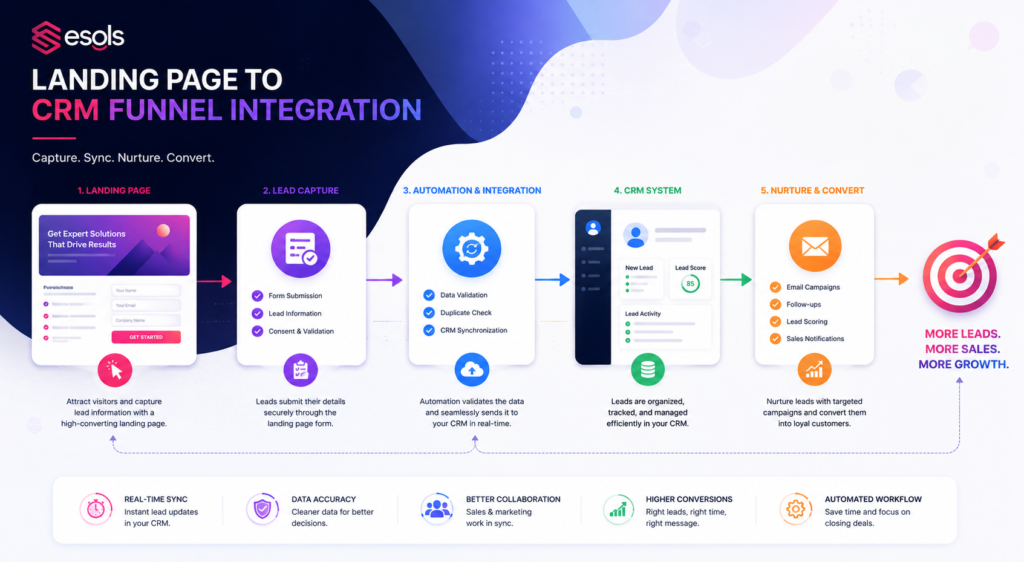
A landing page CRM integration allows new leads to move into the business’s customer management system.
A connected CRM funnel can help organize prospects according to their status, source, service interest, and follow-up stage.
Through lead automation, businesses can also trigger notifications, emails, assignments, or other actions after a form submission.
Landing Page Conversion Tracking Setup
A proper landing page conversion tracking system helps businesses understand what happens after a visitor clicks an advertisement.
Common tools and platforms can provide information about traffic, interactions, conversions, and campaign performance. Google Analytics can be used alongside other tracking technologies to understand user behavior.
Accurate conversion tracking is particularly important when a business is optimizing paid campaigns based on actual leads or sales.
Google Ads Conversion Tracking for Landing Pages
Google Ads conversion tracking helps advertisers measure actions generated by their campaigns.
A business may use Google Tag Manager to manage tracking tags and events, depending on its technical setup.
Reliable PPC tracking can help connect advertising spend with outcomes such as form submissions, phone calls, purchases, or booked appointments.
Meta Pixel Tracking for Landing Page Funnels
Meta Pixel tracking can help businesses measure activity generated by Meta advertising campaigns.
Meta Ads tracking can provide information about interactions and conversions that occur after users engage with advertising.
Businesses can configure relevant conversion events according to their funnel goals, such as lead submissions, registrations, purchases, or other valuable actions.
Landing Page Retargeting Funnel Setup
Not every visitor converts during the first session. A landing page retargeting strategy can reconnect with people who previously interacted with the funnel.
A remarketing funnel may show different messages depending on what the visitor previously did. For example, someone who viewed a service but did not submit a form could receive a reminder or additional proof.
Retargeting ads can therefore support the later stages of the customer journey.
Cold Traffic Landing Page Funnel Strategy
A cold traffic funnel targets people who have not previously interacted with the business.
Because the cold audience may have limited knowledge of the company, the landing page may need to establish credibility, explain the problem, communicate the solution, and introduce the offer clearly.
A paid traffic campaign targeting unfamiliar prospects should therefore avoid assuming that visitors already understand the brand or service.
High-Ticket Service Landing Page Funnel
A high-ticket sales funnel often requires more trust and consideration than a low-cost purchase.
A service funnel for a high-value offer may include detailed benefits, proof, credentials, FAQs, case studies, and an opportunity to speak with a representative.
A consultation funnel can then turn interested visitors into scheduled conversations where the business can understand their requirements.
E-commerce Landing Page Sales Funnel
An e-commerce landing page funnel can guide visitors toward a specific product or product collection.
Instead of sending paid traffic to a generic homepage, businesses can create a focused product funnel around the item or offer promoted in the advertisement.
The experience can move from advertisement to product-focused page, product information, purchase action, confirmation, and post-purchase communication.
This approach can complement a broader sales funnel strategy for online stores.
Landing Page Funnel for Local Businesses
A local business funnel can be designed around geographically relevant services and customer needs.
For example, a local service provider may use paid advertising to attract people searching for a specific service in its area. The landing page can then emphasize service availability, local experience, reviews, contact options, and a clear offer.
A focused lead generation process can help turn relevant visitors into local leads.
Landing Page Funnel Optimization: From Click to Conversion
Funnel optimization is an ongoing process rather than a one-time task.
Businesses can examine the entire journey:
Click → Landing Page → Engagement → Lead/Purchase → Follow-Up → Conversion
If many people click an advertisement but few engage with the page, the problem may be related to relevance, messaging, or page experience.
If visitors engage but do not submit a form, the offer, CTA, trust, or form may need attention.
Looking at the entire journey helps businesses improve the conversion rate rather than focusing on one isolated metric.
Effective funnel CRO combines data, testing, customer feedback, and continuous refinement.
Complete Landing Page Funnel Setup Checklist
A landing page funnel checklist can help businesses verify that every important component is ready before a campaign launches.
Strategy
- Define the target audience
- Identify the primary conversion goal
- Define the offer
- Match the funnel to the traffic source
Landing Page
- Create a clear headline
- Explain the primary benefits
- Add relevant trust signals
- Include a clear CTA
- Build the appropriate form or conversion element
- Optimize the mobile experience
- Check page speed
Tracking
- Configure analytics
- Set up advertising conversion tracking
- Verify important conversion events
- Test forms and tracking
- Confirm that lead data reaches the appropriate system
Follow-Up
- Create the thank-you page
- Connect the CRM where appropriate
- Configure email automation if required
- Establish lead follow-up procedures
- Prepare remarketing audiences
Optimization
- Monitor conversion performance
- Review traffic quality
- Test important page elements
- Analyze funnel drop-off
- Improve weak stages based on data
This funnel setup process gives businesses a practical framework for checking the complete customer journey before investing heavily in traffic.
Final Thoughts
A successful landing page funnel is more than a visually attractive webpage. It is a connected system in which advertising, messaging, page experience, lead capture, tracking, follow-up, and optimization support the same business objective.
For Google Ads and Meta Ads, the landing page should match the audience and advertisement. For service businesses, it should make contacting or booking easy. For e-commerce brands, it should create a direct path toward purchase. For high-value services, it should establish enough trust to encourage a consultation.
The most effective funnels are also continuously improved. Businesses that monitor performance, test important elements, strengthen their offers, and remove unnecessary friction can create a more efficient journey from the first click to the final conversion.
