
Introduction
AI is changing how people search. Instead of typing keywords into a search bar and scrolling through links, users now ask questions directly to AI assistants and get instant answers.
Here’s what’s happening right now:
- Google AI Overviews now appear for over 25% of search queries—pulling answers directly from web pages without users clicking through
- 60% of voice search users are now asking complex, multi-part questions via smart speakers and mobile assistants
- ChatGPT, Claude, Gemini, and Perplexity AI are becoming go-to research tools, citing sources directly in their responses[citation:5]
- By 2026, 50% of all searches will be zero-click—users find their answer without ever visiting a website
This shift creates a challenge for business owners: If AI answers all the questions, how will customers ever find you?
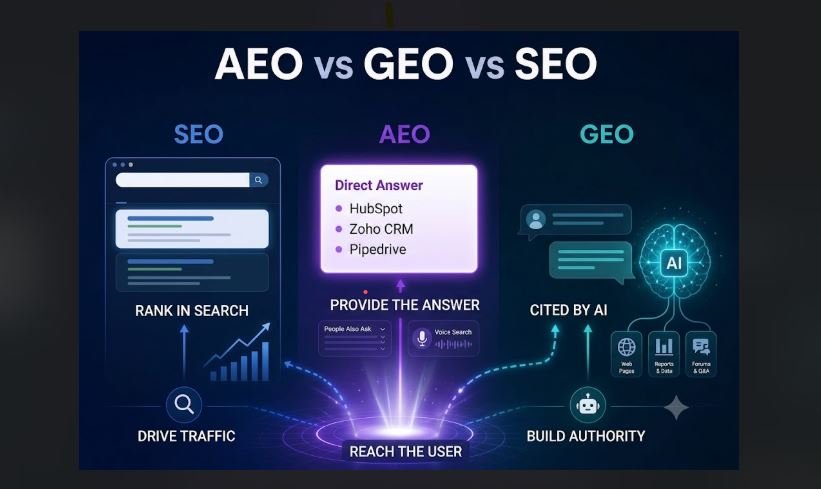
The solution is to optimize your content for both human readers AND AI systems. This strategy is called AI Search Optimization—a combination of GEO (Generative Engine Optimization), AEO (Answer Engine Optimization), and Voice Search Optimization.
ESOLS Technologies, a London-based digital marketing agency with over 10 years of experience, has been helping businesses navigate exactly these shifts. With expertise spanning SEO, PPC, web development, and ecommerce solutions, ESOLS is uniquely positioned to guide you through the AI search revolution.
In this comprehensive guide, you’ll learn exactly how to optimize your content for every major AI platform in 2026.
What Is AI Search Optimization?
AI Search Optimization is the practice of creating content that is discoverable, understandable, and citable by Artificial Intelligence systems—including search engine AI, large language models (LLMs), and voice assistants.
Think of it as an evolution of traditional SEO. While traditional SEO focuses on ranking in search engine results pages (SERPs), AI Search Optimization ensures your content is:
- Extracted and cited in AI Overviews (Google’s AI-generated answers)
- Referenced in responses from ChatGPT, Claude, Gemini, and Perplexity
- Read aloud correctly by voice assistants like Siri and Alexa
- Selected as the source for featured snippets and “People Also Ask” boxes
ESOLS has been tracking this evolution since 2012, helping businesses adapt from basic keyword SEO to the complex, multi-channel optimization required today. As one industry expert noted, “AI search is not just a trend—it’s a fundamental shift in how humans discover information”[citation:8].
Why Traditional SEO Alone No Longer Works

| Challenge | Traditional SEO | AI Search-Optimized Content |
|---|---|---|
| User behavior | Keyword searches | Conversational queries |
| Content format | Blog posts with keywords | Structured answers + supporting content |
| Search result | 10 blue links | AI-generated summary + source links |
| Success metric | Page 1 ranking | Being cited as a source in AI answers |
| Optimization target | Google’s ranking algorithm | Multiple AI systems + search engines |
Key Takeaway: If your content is designed only to rank in traditional search results, you’re missing the 50% of searches that never click through to a website.
The Four Pillars of AI Search Optimization
To succeed in the AI search landscape of 2026, you need to optimize across four distinct but interconnected areas:
1. GEO (Generative Engine Optimization)
What it is: Optimizing content so that generative AI systems (like ChatGPT and Google AI Overviews) can accurately understand, summarize, and cite your information.
Why it matters: Generative engines are becoming primary discovery tools. When users ask a question to ChatGPT or Google’s AI Overview, the AI synthesizes information from multiple sources and provides a single answer. Your goal is to be one of the sources the AI selects and cites.
How it works: Generative engines scan your content for:
- Clear definitions of key terms and entities
- Well-structured information (headings, lists, tables)
- Factual accuracy supported by credible sources
- Comprehensive coverage of a topic (not just superficial mentions)
ESOLS Insight: Generative engines prioritize content that demonstrates topical completeness. This means covering all aspects of a topic, not just the most popular keywords[citation:9].
2. AEO (Answer Engine Optimization)
What it is: Optimizing content to directly answer user questions in a format that AI systems can easily extract and display.
Why it matters: Answer engines (including voice assistants and “People Also Ask” features) pull concise answers directly into search results—creating zero-click experiences.
How it works: Answer engines look for:
- Direct, concise answers to specific questions
- FAQ sections with clear Q&A formatting
- Lists, bullet points, and tables for easy parsing
- “Definition boxes” for key concepts
3. Voice Search Optimization

What it is: Optimizing content to be returned correctly and naturally by voice assistants.
Why it matters: Voice searches are often longer, more conversational, and more localized than text searches.
How it works: Voice assistants prioritize:
- Natural language queries (how people actually speak)
- Question-based content (“What is the best way to…”)
- Mobile-optimized, fast-loading pages
- Local SEO for location-based queries
4. Semantic SEO & Entity SEO
What it is: Optimizing content around topics, concepts, and entities (not just keywords).
Why it matters: AI systems understand content by recognizing relationships between concepts, not just matching text strings.
How it works: Semantic SEO involves:
- Covering entire topics comprehensively
- Using related and supporting keywords naturally
- Building topic clusters linked together
- Establishing authority on a subject through depth
ESOLS Insight: Semantic SEO is the foundation for all other AI optimization. Without clear topic authority, generative and answer engines will ignore your content[citation:10].
Understanding Generative Engine Optimization (GEO) in 2026
Generative Engine Optimization (GEO) is the newest and most rapidly evolving pillar of AI Search Optimization. Let’s explore it in depth.
What Are Generative Engines?
Generative engines are AI systems that generate human-like responses to user queries. The most prominent in 2026 include:
- Google AI Overviews — AI-generated summaries displayed above traditional search results, citing web sources
- ChatGPT Search — OpenAI’s conversational AI with browsing capabilities
- Claude Search — Anthropic’s assistant optimized for complex reasoning
- Perplexity AI — An answer engine that cites sources with high accuracy
- Microsoft Copilot — Microsoft’s AI assistant integrated with Bing Search
- Gemini — Google’s standalone AI assistant
Each of these systems works differently, but all share a common behavior: they scan web content to find the most relevant, accurate, and complete information to answer user questions.
How Generative Engines Select Content
Understanding this selection process is crucial for optimization:
Accuracy and Authority
Generative engines prioritize information that is consistent with other reputable sources. Inconsistencies or factual errors reduce your chances of being cited.
Completeness
A short, superficial article is less likely to be cited than a comprehensive guide covering all aspects of a topic. Generative engines want to answer the user’s entire question, not just part of it.
Structure and Readability
Content that is well-organized with clear headings, lists, tables, and summaries is easier for AI to parse and extract information from.
Entity Richness
Content that clearly defines and connects to recognized entities (people, places, organizations, concepts) is more valuable to generative engines.
Freshness
For topics that change rapidly, newer content has a significant advantage.
GEO Best Practices for 2026
Based on current trends and ESOLS’ experience in the field, here are the critical GEO best practices:
1. Write in Complete Topic Clusters
Don’t write isolated articles. Write comprehensive guides that cover subtopics and link them together in a hub-and-spoke model.
2. Use “Definition Boxes”
When introducing a key term or concept, include a clear, concise definition in a boxed or highlighted format. This gives generative engines an easy “entity definition” to extract.
Example:
What is Generative Engine Optimization (GEO)?
Generative Engine Optimization (GEO) is the practice of optimizing content so that generative AI systems—including ChatGPT, Google AI Overviews, and Perplexity AI—can accurately understand, summarize, and cite it in their responses.
3. Answer Questions Directly
For every important question related to your topic, provide a direct, concise answer at the beginning of your response. This is called “answer-first” writing.
4. Structure with Clear Headings
Use H2 and H3 headings that reflect the user’s likely search journey. Your H2 headings should look like the questions people are asking.
5. Include Supporting Evidence
Cite your sources. Generative engines look for external validation of your claims.
6. Optimize for “Featured Snippet” Format
Even though featured snippets are a Google feature, the format (concise answers, lists, tables) is also optimized for generative engines.
7. Build Internal Topic Authority
If your website is the most comprehensive resource on a topic, generative engines are more likely to cite it.
Answer Engine Optimization (AEO): Complete Guide

Answer Engine Optimization (AEO) focuses specifically on making your content answer questions directly—the type of answers that appear in “People Also Ask,” featured snippets, and voice search responses.
The Rise of Zero-Click Searches
A zero-click search occurs when a user finds the answer directly on the search results page and doesn’t click through to a website. By 2026, 50% of all searches are zero-click[citation:7].
This means:
- If your content provides the perfect answer, users get value from your content without visiting your site
- If your content doesn’t provide the answer, users may never find you at all
The solution is to win both ways:
- Provide the answer so you get cited (GEO/AEO win)
- Provide additional depth so users who want more click through (Conversion win)
How to Structure Content for AEO
1. Build a Comprehensive FAQ Section
Include 40-60 frequently asked questions at the bottom of your articles. For each question, provide a direct, concise answer (1-3 sentences) followed by 1-2 paragraphs of additional context.
Example:
How do I optimize my website for AI search in 2026?
To optimize for AI search, you need to combine traditional SEO with GEO and AEO. Start by ensuring your content is comprehensive, well-structured, and answers user questions directly.
Key steps include: (1) Conducting entity-based keyword research, (2) Structuring content with clear headings, (3) Including definition boxes for key terms, (4) Building a robust FAQ section, and (5) Creating topic clusters that demonstrate authority.
2. Use “Answer-First” Paragraphs
Start each paragraph with a clear answer, then provide supporting context. This format works well for both human readers and AI systems.
3. Include “Snippet-Ready” Elements
- Lists: For steps, benefits, features
- Tables: For comparisons and data
- Bullet Points: For summarizing key points
- Charts: For displaying trends
4. Create “Pros and Cons” Sections
For decision-oriented topics, include a clear pros and cons breakdown.
5. Include “Definition Boxes”
For complex terms, provide concise definitions in boxed formats.
6. Add “Summary Boxes” or “Key Takeaways”
Give AI systems an easy way to extract the most important information from your article.
AEO Best Practices Checklist
- Answer the primary question within the first 200 words
- Use question-based H2 and H3 headings
- Include 40+ FAQs with direct answers
- Use definition boxes for complex terms
- Include lists and tables for structured data
- Add a key takeaways section
- Write in a conversational, accessible tone
- Ensure mobile readability for voice search users
Voice Search Optimization: Complete Guide
Voice search is growing rapidly. By 2026, over 60% of mobile users use voice search regularly[citation:11]. Voice queries are typically:
- Longer and more conversational
- Question-based (“What is…”, “How do I…”)
- Local (“Near me” queries)
- Hands-free (driving, cooking, etc.)
How Voice Search Differs from Text Search
| Factor | Text Search | Voice Search |
|---|---|---|
| Query Length | Short (3-5 words) | Long (8-15 words) |
| Language | Keywords | Natural, conversational |
| Intent | Broad | Specific |
| Device | Mobile/Desktop | Smartphone/Smart Speaker |
| Context | Less important | Very important (location, time, etc.) |
Optimizing for Voice Search
1. Use Natural, Conversational Language
Your content should sound like someone explaining something to a friend, not a formal document. Voice assistants recognize and prioritize natural language.
2. Target Question-Based Queries
Voice searches are typically questions. Optimize for common question starts:
- “What is…”
- “How do I…”
- “Why should I…”
- “Which is the best…”
- “Can AI…”
- “How much…”
- “Is it worth…”
3. Write in a Read-Aloud Tone
Read your content aloud. Does it sound natural? Voice assistants prefer content that sounds good when read aloud by a synthetic voice.
4. Optimize for Featured Snippets
Voice assistants often pull directly from featured snippets. Use the “answer-first” approach to win these positions.
5. Use Schema Markup
Schema helps voice assistants understand your content’s structure and meaning.
6. Ensure Fast Mobile Loading
Voice searches happen on mobile. Slow pages lose voice search visibility.
7. Optimize Local SEO
Many voice searches are local. Ensure your Google Business Profile is complete and accurate.
Semantic SEO and Entity SEO: The Foundation
While GEO, AEO, and Voice Search are the pillars, Semantic SEO and Entity SEO are the foundation. Without these, your other optimizations won’t work effectively.
What Is Semantic SEO?
Semantic SEO is the practice of covering a topic comprehensively, not just optimizing for individual keywords. It’s about understanding the user’s actual intent and the relationships between concepts.
Traditional SEO: Write about “AI search optimization” and include that keyword 5 times.
Semantic SEO: Write a comprehensive guide covering AI search optimization, including related concepts like GEO, AEO, voice search, LLMs, zero-click searches, featured snippets, entity optimization, topic clusters, etc.
What Is Entity SEO?
Entity SEO focuses on optimizing content around entities—things that are distinct, identifiable, and have relationships to other things.
Entities include:
- People (Bill Gates, John Mueller)
- Places (London, New York)
- Organizations (ESOLS Technologies, Google)
- Concepts (Generative Engine Optimization, Semantic Search)
- Products (ChatGPT, Google Search)
Why entities matter: AI systems understand content by recognizing entities and their relationships. The more entities you cover and link together, the better AI understands your content.
Building Topic Clusters
Topic clusters are the practical application of semantic SEO:
Hub: A comprehensive pillar page covering a broad topic
Spokes: Detailed articles covering subtopics, linking back to the hub
Example for ESOLS:
- Hub: Complete Guide to AI Search Optimization
- Spokes:
- GEO Best Practices for 2026
- AEO FAQ Optimization Guide
- Voice Search Optimization for Ecommerce
- How to Structure Content for AI Overviews
- Entity SEO for Business Websites
Implementing Semantic SEO
1. Conduct Entity-Based Keyword Research
Instead of just finding keywords, identify:
- What entities are related to your topic?
- What questions are users asking about these entities?
- What subtopics need to be covered?
2. Cover Topics, Not Just Keywords
For every piece of content, ask: “Have I covered everything a user needs to know about this topic?”
3. Use Related Terms Naturally
Don’t force keywords. Use related terms and synonyms naturally throughout your content.
4. Build Internal Links Between Related Content
Internal linking helps AI systems understand the relationships between your content.
5. Include Supporting Sources
External links to authoritative sources demonstrate your content’s credibility.
How ESOLS Implements AI Search Optimization
ESOLS Technologies has been helping businesses implement effective digital strategies since 2012, and the company’s approach to AI Search Optimization is comprehensive:
1. Comprehensive Website Analysis
ESOLS begins by analyzing your website’s current state, including:
- Technical SEO issues
- Content gaps
- Entity coverage
- Internal linking structure
2. Market and Competitor Research
Based on search results, ESOLS conducts deep research to identify:
- What topics your audience is searching for
- What your competitors are covering
- Gaps in the current content landscape
3. Keyword and Entity Research
As noted, ESOLS identifies both traditional keywords and semantic entities to target.
4. Content Strategy and Creation
ESOLS creates comprehensive, well-structured content optimized for both users and AI systems.
5. Technical SEO Implementation
Technical factors (schema markup, site speed, mobile optimization) are optimized to support AI discoverability.
6. Ongoing Monitoring and Optimization
AI search is evolving rapidly. ESOLS monitors algorithm changes and adapts strategies accordingly.
Actionable Checklist for Implementing AI Search Optimization
Use this checklist to optimize your content for AI search:
Content Structure
- Start with a clear introduction that answers “why this matters”
- Use H2 headings that reflect user questions
- Use H3 headings for subtopics
- Include definition boxes for key terms
- Add summary boxes or key takeaways sections
- Include 40+ FAQs with direct answers
Content Quality
- Cover all aspects of the topic comprehensively
- Use factual, accurate information
- Cite authoritative sources
- Write in a conversational, readable tone
- Include practical examples and case studies
- Add tables, lists, and bullet points for structured information
Technical SEO
- Optimize meta titles and descriptions
- Use descriptive URL slugs
- Implement schema markup
- Ensure fast mobile loading
- Use internal linking strategically
Semantic SEO
- Cover topic clusters comprehensively
- Link related content together
- Use related terms naturally
- Include entity-rich content
AI and Answer Optimization
- Answer key questions directly (answer-first)
- Write content that sounds natural when read aloud
- Optimize for featured snippets
- Use question-based content
FAQs
AI Search Optimization is the practice of creating content that is discoverable, understandable, and citable by Artificial Intelligence systems—including search engine AI, large language models (like ChatGPT and Claude), and voice assistants.
With 50% of searches now being zero-click, and AI assistants citing sources in their responses, traditional SEO alone is no longer enough. AI Search Optimization ensures your business remains visible even when users get answers without clicking through to websites.
Traditional SEO focuses on ranking in search engine results pages. GEO (Generative Engine Optimization) focuses on being cited by generative AI systems. AEO (Answer Engine Optimization) focuses on providing direct, extractable answers to user questions.
Start by auditing your existing content for completeness, structure, and answer-first formatting. Then, implement topic clusters, include comprehensive FAQs, and ensure your content uses conversational, entity-rich language.
GEO is the practice of optimizing content so that generative AI systems—including ChatGPT, Google AI Overviews, and Perplexity AI—can accurately understand, summarize, and cite it in their responses.
Key GEO best practices include: writing in complete topic clusters, using definition boxes, answering questions directly, using clear headings, including supporting evidence, and building internal topic authority.
AEO is the practice of optimizing content to directly answer user questions in a format that AI systems can easily extract and display—often resulting in featured snippets and “People Also Ask” appearances.
Best practice recommends 40-60 FAQs per comprehensive article, each with a direct, concise answer and 1-2 paragraphs of additional context.
Answer-first writing means starting each paragraph with a clear, direct answer to a question, then providing supporting context. This format is optimized for both human readers and AI systems.
To win featured snippets, provide clear, concise answers to questions, use lists and tables for structured information, and structure your content with question-based headings.
To optimize for voice search, use natural, conversational language, target question-based queries, write in a read-aloud tone, optimize for featured snippets, use schema markup, and ensure fast mobile loading.
Entity SEO focuses on optimizing content around entities (people, places, organizations, concepts) and their relationships. AI systems use entities to understand content meaning.
Topic clusters are a hub-and-spoke content model where a comprehensive pillar page covers a broad topic and detailed articles cover subtopics. Topic clusters demonstrate authority to AI systems.
Identify entities by understanding what people, places, organizations, concepts, and products are relevant to your topic. Use tools like Google’s Knowledge Graph or entity extraction tools.
Conclusion
AI Search Optimization is not a trend—it’s the future of digital visibility. As 50% of searches become zero-click, and as generative engines like ChatGPT and Google AI Overviews cite sources in their answers, businesses that fail to adapt will become invisible.
The good news is that AI Search Optimization builds on traditional SEO best practices rather than replacing them. By adding GEO, AEO, and Voice Search optimization, you can future-proof your content.
