
Introduction: The Search World Has Changed (Again)
Let me ask you something.
When was the last time you asked ChatGPT a question instead of typing it into Google?
If you are honest, probably today. Maybe an hour ago.
Here is the reality nobody is talking about loudly enough: AI tools like ChatGPT, Gemini, and Perplexity are becoming the new search engines. And if your content is not optimized for them, you are invisible — not just on Google, but everywhere.
I have been in SEO for over a decade. I have survived Penguin, Panda, and countless core updates. But this shift? This one is different.
This is not an algorithm tweak. This is a platform shift.
So let me walk you through exactly how to optimize your content for AI search — step by step, without the fluff.
What Is AI Content Optimization? (And Why It Matters)
Let us break this down simply.
Traditional SEO = optimizing for Google’s crawlers.
AI content optimization = optimizing for large language models (LLMs) like ChatGPT, Gemini, and Perplexity that read, understand, and summarize your content to answer user questions directly.
You will hear three terms thrown around:
| Term | What It Means |
| GEO (Generative Engine Optimization) | Optimizing content so AI tools cite or summarize it |
| AEO (Answer Engine Optimization) | Optimizing to provide direct, concise answers |
| AI SEO | Traditional SEO adapted for AI-driven search |
Here is the simple truth: If an AI cannot understand your content, it will never show it to users.
How ChatGPT, Gemini & Perplexity Actually Rank Content
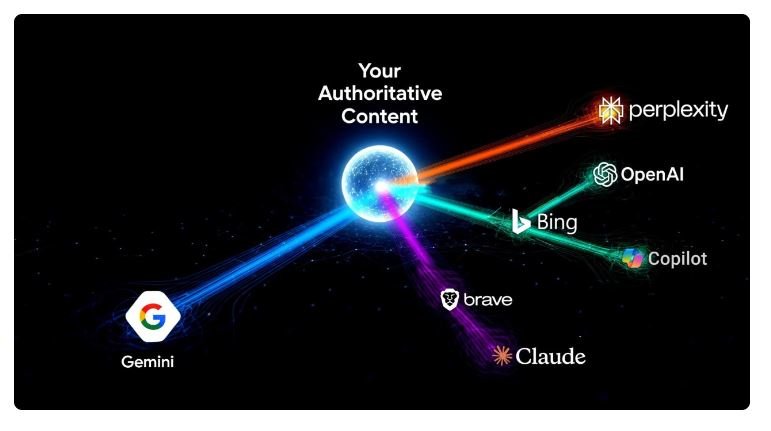
This is where most people get confused.
AI search engines do not have “rankings” the way Google does. But they absolutely have selection logic.
Here is what these AI tools look for when deciding which content to use:
1. Source Authority
If your website has strong E-E-A-T (Experience, Expertise, Authoritativeness, Trustworthiness), AI models trust you more.
2. Clarity & Structure
AI loves clean headings, bullet points, and short paragraphs. Chaos confuses the model.
3. Direct Answers
If you answer a question immediately and clearly, AI will pick your content over a vague blog that buries the answer.
4. Semantic Richness
AI understands related topics. If you cover a subject thoroughly with natural language variations, you win.
5. Freshness
ChatGPT and Gemini prefer recent, updated content — especially for news, trends, and local information.
Step-by-Step Strategy to Optimize Content for AI Search
Let me give you a practical framework. I use this for my own clients, and it works.
Step 1: Use Keyword Clusters, Not Single Keywords
Forget the old “one keyword per page” nonsense.
AI understands topic clusters. If you are writing about “local SEO,“ you should naturally mention:
- Google Business Profile
- near me searches
- citation building
- review management
Example: Instead of repeating “optimize content for AI search” twenty times, write about “AI search engine optimization,” “generative AI visibility,” and “content for ChatGPT ranking” naturally throughout the article.
Step 2: Write Like You Talk (Seriously)
AI models are trained on human conversation.
If you write in a stiff, robotic, corporate voice, AI struggles to understand you — and worse, it will not cite you.
Robotic: “Implementation of optimal keyword strategies facilitates enhanced visibility within generative AI platforms.”
Human: “If you use the right keywords naturally, AI tools will find your content easier.”
See the difference? Be the second one.
Step 3: Structure Your Content for Instant Answers
Here is a secret most SEOs do not know yet:
AI tools often read the first 100–200 words of a section to decide if it is useful.
So put your best answer right at the beginning of each heading.
Bad structure: A long story before answering the question.
Good structure: “Here is the answer. Now let me explain why.”
Step 4: Add FAQ Sections (AI Loves These)
Every single blog post you write should have an FAQ section at the bottom.
Why? Because AI models are trained to extract question-answer pairs. FAQs are like candy to ChatGPT and Gemini.
Make sure your FAQs are:
- Real questions people ask
- Answered in 1–2 sentences (directly)
- Followed by a short explanation if needed
Step 5: Use Schema Markup (Still Important)
Yes, schema still matters. Probably more than ever.
Add these schema types to every blog post:
- FAQ schema (even if Google does not always show it, AI reads it)
- HowTo schema (for tutorial content)
- Article schema (for news and blogs)
AI crawlers love structured data. It helps them understand your content instantly.
Step 6: Build Real E-E-A-T Signals
You cannot fake authority anymore. AI models are getting scary good at detecting fluff.
Here is what actually builds trust with AI search engines:
Author bios with real experience
Citations and references to credible sources
Internal links to other detailed content on your site
External links to high-authority domains (not spam)
Regular content updates (show you are active)
Practical Content Writing Tips for AI Visibility
Let me give you five things you can do today to make your content more AI-friendly.
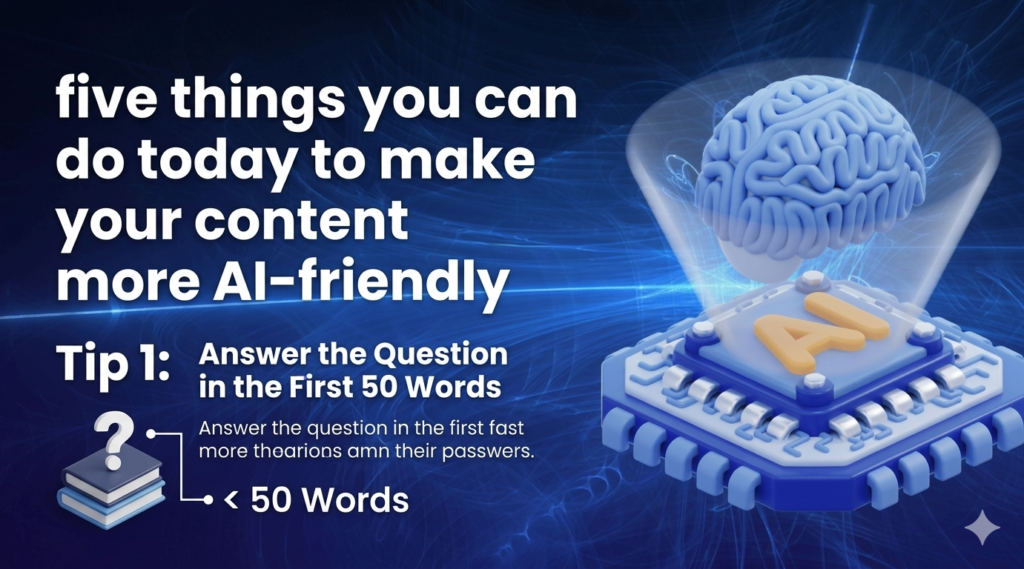
Tip 1: Answer the Question in the First 50 Words
If your title is “How to optimize content for AI search,” your first sentence should start answering that immediately.
Example: “To optimize content for AI search, you need clear structure, direct answers, and strong E-E-A-T signals. Let me show you exactly how.”
Tip 2: Use H2 and H3 Headings Like Road Signs
AI reads headings to navigate your content.
Make your headings descriptive, not clever.
“The Thing You Need to Know”
“Why AI Search Prefers Direct Answers”
Tip 3: Keep Paragraphs Short (2–3 Sentences Max)
Huge walls of text confuse AI models and lose human readers.
Break it up. Your future self will thank you.
Tip 4: Add Real Examples and Case Studies
AI loves specific, concrete information.
Instead of saying “good content ranks well,” say:
“Last month, we optimized a client’s FAQ section and added schema markup. Within two weeks, ChatGPT started citing their content for three different search queries.”
That is gold.
Tip 5: Write for Humans First, AI Second
This sounds counterintuitive, but it is the most important rule.
If a human enjoys reading your content, AI will probably like it too. The reverse is not always true.
So write naturally. Tell stories. Be helpful. The AI optimization will follow.
Mistakes to Avoid (I Have Made All of These)

ESOLS
Let me save you some pain.
Keyword Stuffing
AI models are smart. If you cram “optimize content for AI search” fifteen times in one paragraph, you look spammy. Stop it.
Robotic, Generic Writing
“In the current digital landscape, optimization strategies must evolve…”
Boring. AI ignores boring. Humans ignore boring. Write like a person.
Ignoring User Intent
If someone asks “how to optimize content for ChatGPT,” do not give them a history of AI development. Give them steps. Now.
No Internal Linking
AI models crawl your site like Google does. If you never link to your other content, you look like a one-page wonder.
Old, Stale Content
AI prioritizes fresh, updated content. If your last blog post was from 2022, you are invisible.
The Future of SEO: From Google-Only to AI-First Discovery
Here is what I tell my clients in 2026.
For fifteen years, SEO meant “rank on Google.”
That world is ending.
Not because Google is dying — but because search is fragmenting.
Today, a user might:
- Ask ChatGPT for a product recommendation
- Check Perplexity for a news summary
- Search Google for a local business
- Ask Gemini to compare two services
If your content is only optimized for Google, you are missing three out of four of those opportunities.
The future is AI-first SEO:
- Optimizing for large language models
- Writing for answer engines (AEO)
- Building authority that works across all platforms
The good news? The fundamentals still matter. Great content, clear structure, real expertise — these never go out of style.
You just need to adapt how you present them.
FAQ: Content Optimization for AI Search
SEO (Search Engine Optimization) helps your content rank on Google. AEO (Answer Engine Optimization) helps your content get cited by AI tools like ChatGPT and Gemini as a direct answer source.
Yes — ChatGPT with browsing enabled, Gemini, and Perplexity AI all pull current web content. That means your recent, well-optimized blog posts can appear in their answers.
Yes — ChatGPT with browsing enabled, Gemini, and Perplexity AI all pull current web content. That means your recent, well-optimized blog posts can appear in their answers.
Yes — but differently. AI tools understand semantic clusters. Research related terms, questions, and natural language phrases, not just high-volume keywords.
If you optimize existing content properly, you may see AI citations within 2–4 weeks. For new content, 4–8 weeks is realistic.
Final Thoughts (Read This)
Look — I am not going to pretend this is easy.
SEO has always been a moving target. But this shift to AI-first search is the biggest change I have seen in my entire career.
Here is what I want you to remember:
Do not panic. Do not chase every trend. But do not ignore this one either.
Start small. Add FAQs to your next blog post. Write clearer headings. Answer questions directly. Build real expertise.
The AI tools are watching. Make sure they find you.
Need help optimizing your content for ChatGPT, Gemini, and Perplexity AI?
Contact ESOLS today — we specialize in future-proof SEO and AI search optimization.
