

Quick answer: what are the biggest Amazon seller updates in 2026?
The changes with the largest effect on sellers are the 75-character product title limit (enforced from 27 July 2026), a 3.5% fuel and logistics surcharge on US and Canada FBA fulfilment fees (from 17 April 2026), the rebrand of Rufus into Alexa for Shopping, and a wave of AI tools across Seller Assistant, PPC and Amazon Ads. Fee changes also differ by marketplace, so UK, EU and US sellers are not in the same position.
Table of contents
- Quick answer: what are the biggest Amazon seller updates in 2026?
- Why this year feels different for Amazon sellers
- Part 1: Amazon fee changes in 2026 and what they do to your margin
- Part 2: Listings and product discovery in 2026
- Part 3: AI tools inside Seller Central and Amazon Ads
- 6. Seller Assistant is becoming more autonomous
- 7. Seller Central is moving towards a unified workspace
- 8. AI-powered PPC optimisation is expanding
- 9. Amazon Ads Agent brings conversational campaign management
- 10. Ads Data Manager and first-party data
- 11. AI-powered Sponsored Brands Collections
- 12. Amazon advertising is expanding across more formats
- Part 4: New growth channels for Amazon sellers
- Part 5: Compliance you shouldn’t ignore
- Part 6: What independent data and experts are saying
- What Amazon sellers should do next: a 7-step plan
- Frequently asked questions about Amazon seller updates in 2026
- Conclusion: sell with better data, not more features
Why this year feels different for Amazon sellers
Most Amazon updates used to arrive as small tweaks: a fee here, a policy there. 2026 is different because the changes touch the three things every seller depends on at once: what you pay, how customers find you, and how much of your own account Amazon wants to run with AI.
That combination is why I’d rather not give you a news feed. Plenty of sites will list every announcement. What’s more useful is knowing which changes can move your margin, which ones are still rolling out, and which ones are mostly noise.
So this guide groups the 20 updates by what they affect, flags where a number comes from Amazon rather than from independent research, and ends with a practical plan you can start this week.
One caution before we begin. Amazon policies and feature availability vary by marketplace and rollout stage. Confirm anything that affects your account in Seller Central before you act.
Key takeaways
- Fulfilment costs rose in the US but fell in parts of Europe, so check fees marketplace by marketplace.
- Titles above 75 characters are now rewritten by Amazon’s AI if you don’t do it yourself.
- Conversational shopping is growing, but there’s no proof it replaced Amazon’s organic ranking system.
- Amazon’s AI results are Amazon-reported. Treat them as signals, not guarantees.
- Profit, not revenue, should be the scoreboard for every change you test.
Part 1: Amazon fee changes in 2026 and what they do to your margin
Fees are where most sellers feel 2026 first. Three updates matter here.
1. Amazon FBA fees changed in January 2026
Amazon announced updates to US referral and Fulfilment by Amazon (FBA) fees in October 2025, with most changes taking effect on 15 January 2026. According to Amazon, FBA fees rose by an average of $0.08 per unit sold, which it described as less than 0.5% of an average selling price. Amazon also said it would not introduce new FBA fee types as part of that update.
Averages hide a lot. Your real impact depends on product dimensions, shipping weight, category, fulfilment method and how well you manage inventory. A seller with small, light, fast-moving products and a seller with bulky slow movers can read the same announcement and reach opposite conclusions.
Amazon also introduced better profitability tools, including a Profit Analytics dashboard and updated fee-preview tools.
What to do:
- Recalculate margins for individual ASINs, not for the catalogue as a whole.
- Review fulfilment, referral, storage and inbound placement costs together.
- Compare FBA with alternative fulfilment where it makes sense.
- Track contribution margin, not revenue alone.
2. The 3.5% fuel and logistics surcharge
On 17 April 2026, Amazon added a 3.5% fuel and logistics surcharge to FBA fulfilment fees in the US and Canada, and to remote fulfilment with FBA from the US into Canada, Mexico and Brazil. Multi-Channel Fulfilment and Buy with Prime followed on 2 May 2026. Trade press reported an average impact of about $0.17 per US FBA unit, higher for large or bulky items.
The detail that trips people up: the 3.5% applies to the fulfilment fee, not to your selling price.
Here’s an illustrative calculation. If a product carries a $5.00 fulfilment fee, the surcharge adds about $0.18. That sounds small until you stack it on advertising, discounts, returns and storage. On a $30 product with thin margins, a few cents per unit can decide whether a campaign is worth running.
What to do: Run your top ASINs through the Revenue Calculator and fee-preview reports, then adjust pricing or ad targets where the new figure breaks your assumptions.
3. European sellers received fee reductions
Not every marketplace moved in the same direction. Amazon announced average European fee reductions of roughly £0.15 or €0.17 per unit sold. Selected changes included:
- UK clothing referral fees cut from 8% to 5% for products priced at or below £15.
- Home Products referral fees cut from 15% to 8% for eligible products priced at or below £20.
- Low-price FBA eligibility expanded to products up to £20 in most categories.
- Average low-price FBA savings of £0.40 or €0.45 for newly eligible products.
Many of these took effect in December 2025 and January 2026.
This is why “Amazon fees went up” is only half the story. A product that works in the UK may not work in the US, and the reverse is just as true.
What to do: Before expanding internationally, check category-specific referral fees, fulfilment eligibility and low-price programme rules for the exact marketplace.
Part 2: Listings and product discovery in 2026
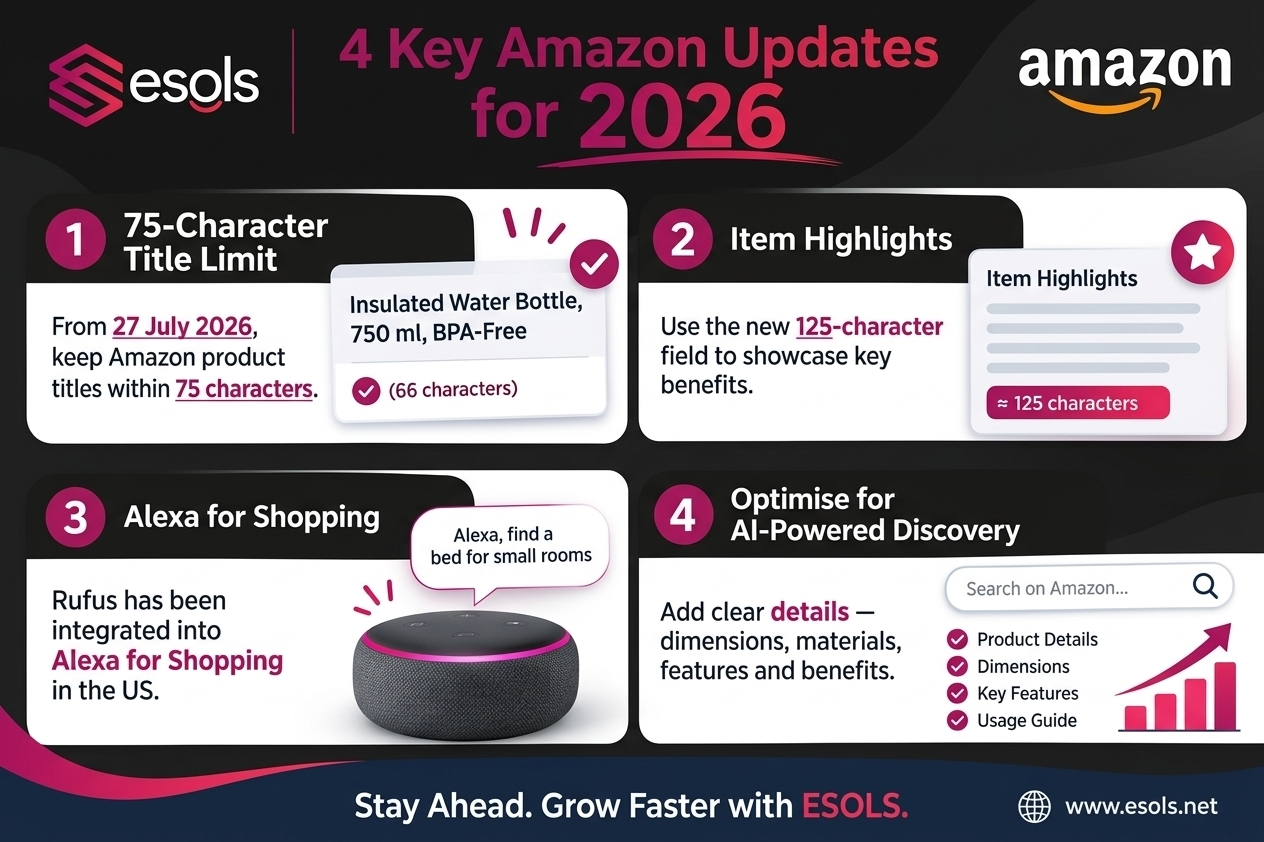
This is the part of the year I’d put at the top of any audit, because it changes how every listing in your catalogue appears.
4. The 75-character product title limit
Amazon announced in June that product titles in every category except media must be 75 characters or fewer, including spaces, from 27 July 2026. Amazon’s stated reasons include showing full titles on mobile screens. Titles that exceed the limit can be updated to Amazon’s AI-generated recommendation.
To soften the cut, Amazon introduced Item Highlights, a field of up to 125 characters shown below the title, for materials, recommended uses and other useful details. Amazon has said Item Name and Item Highlights both contribute to search, with neither receiving priority over the other.
Brand owners can review recommended changes in Seller Central, so you aren’t forced to accept whatever the AI produces.
A hypothetical before-and-after
Imagine an old-style title that reads like a paragraph, crammed with every keyword you could think of. The new structure separates the product’s identity from its supporting detail:
- Title (66 characters): BrandName Insulated Stainless Steel Water Bottle, 750 ml, BPA-Free
- Item Highlights (about 96 characters): Keeps drinks cold for 24 hours and hot for 12. Leak-proof lid. Ideal for gym, office and travel.
(This is an illustrative product, not a real listing. Only claim what your product can actually do.)
How I’d approach it:
- Start with your top revenue ASINs, not the whole catalogue.
- Keep the brand, product type and the details a shopper uses to identify the item in the title.
- Move benefits and use cases into Item Highlights, bullets and the description.
- Read every AI-suggested rewrite before approving it. “Shorter” is not the same as “better.”
- Compare search visibility and conversion before and after, using the same time window.
5. Rufus became Alexa for Shopping
In May 2026, Amazon retired the Rufus brand in the US and folded it into Alexa for Shopping. At Amazon Accelerate 2026, the company said more than 350 million customers had used the experience in the previous 12 months. Other marketplaces may still show the Rufus name for now.
What matters for sellers is shopper behaviour. People increasingly ask questions in plain language, such as whether a bed fits a small bedroom, has under-bed storage, or can be assembled without help. Clear dimensions, materials, compatibility details, instructions and benefits answer those questions for both people and AI assistants.
Here’s the important distinction, and one I’d keep repeating to clients: the growth of conversational shopping does not prove that Amazon replaced its organic ranking algorithm. Several industry guides describe Alexa for Shopping as running alongside traditional search. Be wary of anyone presenting unconfirmed “new ranking factors” as fact.
What to do: Audit listings for the questions a real shopper would ask, then make sure your attributes, bullets, images and Q&A answer them honestly.
Part 3: AI tools inside Seller Central and Amazon Ads

This group is the most hyped and the easiest to misread, so I’ve kept each claim tied to its source.
6. Seller Assistant is becoming more autonomous
At Amazon Accelerate 2026, Amazon highlighted Seller Assistant capabilities including persistent business context, automated workflows, inventory monitoring, pricing recommendations and advertising support. Depending on the workflow and your permissions, you can choose whether it gives insights, drafts actions or carries out authorised tasks.
Amazon reported that sellers act on roughly 90% of Seller Assistant’s recommendations. That’s an Amazon-reported figure, not an independently audited benchmark.
A practical example: the assistant notices a product’s sales declining, links it to an inventory gap or ad performance, and suggests a fix. That could save real time on analysis.
What to do: Start with repeatable, low-risk tasks like inventory monitoring and performance analysis. Set approval limits, and review anything that touches pricing, spend or customers.
7. Seller Central is moving towards a unified workspace
In September 2026, Amazon announced Seller Central improvements aimed at connecting marketing, finance, orders and supply chain in one environment, with AI-assisted management and a stronger focus on international and multichannel selling.
The upside is less admin and faster access to decision-ready data. The caveat is that availability varies by marketplace and rollout stage.
What to do: Check which features your account actually has, then simplify workflows only where reporting accuracy and operational controls stay intact.
8. AI-powered PPC optimisation is expanding
Amazon showed AI features at Accelerate 2026 that help prepare and optimise Sponsored Products and Sponsored Brands campaigns. These include identifying effective search terms, pausing weak ones, managing bids within seller-set limits, and checking whether listings and inventory are ready for advertising.
Amazon reported that campaigns using the new optimisation capability achieved their first sale 40% faster in early results. Read that carefully. A faster first sale doesn’t automatically mean lower ACOS, higher profit or stronger long-term performance, and it’s not guaranteed for every account.
AI reduces repetitive work. It doesn’t replace commercial judgement. Keep watching:
- ACOS and TACOS
- Cost per click (CPC)
- Conversion rate
- Organic versus paid sales
- Contribution margin after advertising
- Inventory availability and stockout risk
What to do: Compare automated and manually managed campaigns over the same measurement period, and judge them on profit as well as sales growth.
9. Amazon Ads Agent brings conversational campaign management
On 29 September 2026, Amazon Ads announced Amazon Ads Agent, an AI-powered advertising platform that builds on its conversational campaign tools. Announced capabilities include media planning and audience forecasting, natural-language audience targeting, performance analysis and trend diagnosis, recommendations for Sponsored Products targeting, bids and budgets, and full-funnel planning. Amazon said these would roll out over the coming months.
The direction is clear: describe an objective in natural language instead of configuring everything by hand. For agencies and in-house teams, that can cut reporting and routine adjustment time. Strategy, attribution, creative testing and profitability analysis still need a person.
What to do: Track availability in your marketplace and test it against your existing workflow before changing a campaign process that already works.
10. Ads Data Manager and first-party data
Amazon introduced Ads Data Manager to help advertisers connect first-party customer data to Amazon advertising. Amazon reported that advertisers using it saw 30% better return on ad spend. Attribute that to Amazon, and don’t treat it as a promise. Results depend on data quality, audience size, objectives, measurement method and implementation.
What to do: Before adopting anything, confirm that you have suitable customer data, the right permissions and a sound data-handling process.
11. AI-powered Sponsored Brands Collections
In May 2026, Amazon announced AI-powered Sponsored Brands Collections, a new way to group and promote related products. Advertisers can let AI select products or choose them manually. It suits brands with complementary products or variations, for example a home furnishings brand promoting matching bedroom items together instead of one by one.
Impact will depend on relevance, creative quality, targeting, pricing and conversion.
12. Amazon advertising is expanding across more formats
Beyond classic sponsored product placements, Amazon is adding AI-assisted planning, wider audience targeting and formats that link discovery with broader shopping experiences. The challenge isn’t adopting every new format. It’s finding which ones bring in customers profitably.
What to do for items 11 and 12: Test new formats with a clear objective, a defined budget and consistent measurement. Judge incremental results against existing campaigns rather than relying only on attributed sales.
Part 4: New growth channels for Amazon sellers
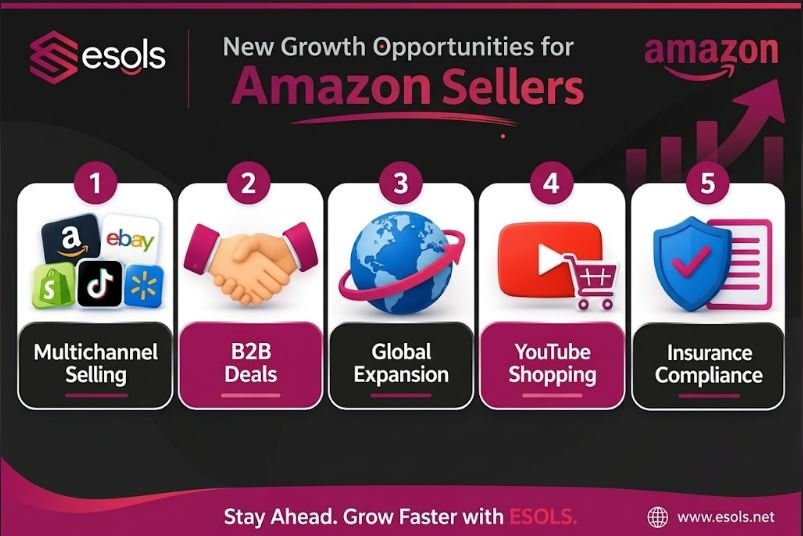
13. Multichannel orders inside Seller Central
Amazon announced tools that let eligible US sellers connect accounts on eBay, Shopify, TikTok and Walmart. Initial capabilities include connecting accounts, importing and linking listings, viewing orders across channels, and fulfilling off-Amazon orders with Amazon fulfilment services. Amazon described a gradual rollout at no additional cost to sellers.
For businesses juggling several storefronts, centralising orders and inventory can reduce errors. Don’t assume every future capability is live today.
What to do: Check availability in your account and compare the supported workflows with your current multichannel software before consolidating anything.
14. Amazon Business Deals open a B2B opportunity
Amazon Business Deals, announced in September 2026, let sellers create exclusive deals for business customers without additional deal fees. These are Amazon-reported comparisons, not guaranteed outcomes.
The opportunity is strongest for office equipment, furniture, supplies and anything organisations buy in volume. B2B buyers care about pack sizes, repeat purchasing, business pricing and invoicing.
What to do: Decide whether your category suits business buyers, then make sure listings state pack sizes, specifications and commercial use cases clearly.
15. Global selling and logistics are becoming more connected
Amazon continues to develop tools for international expansion, multichannel management and logistics. The benefits can include reaching more customers, reusing listings in more markets and gaining better operational visibility.
Expansion also brings taxes, product compliance, localisation, import requirements, customer service and fulfilment costs. A product that performs well in one country may not have the same demand or margin in another.
What to do: Evaluate each market on demand, competition, landed cost, compliance obligations and a realistic profit forecast.
16. YouTube Shopping now includes Amazon
Amazon joined the YouTube Shopping Affiliate Program in the US in August 2026, so eligible creators can tag Amazon products in videos, Shorts and livestreams. YouTube reported that in a July 2026 experiment, videos with product tags generated more than 110% more product clicks than videos with description links alone. That’s a YouTube-reported experiment, not proof of higher sales or earnings.
It’s most relevant where demonstrations, comparisons and reviews drive purchasing.
What to do: Evaluate creator partnerships on clicks, conversion rate, attributable sales, commission costs and returns, not views alone.
Part 5: Compliance you shouldn’t ignore
17. Commercial liability insurance requirements
Amazon’s US seller policies include commercial liability insurance requirements that can apply depending on sales levels, product categories and other eligibility criteria. For sellers under the general requirement, the established threshold has been more than $10,000 in monthly gross proceeds, with at least $1 million in coverage.
Changes effective 2 November 2026 add requirements for certain enhanced-safety product categories regardless of the general sales threshold, and the policy includes special arrangements for mainland China-based sellers.
Because obligations depend on product type, seller location and exact policy wording, read the current policy in Seller Central rather than relying on a summary, including this one.
What to do: Review your insurance documents, confirm your products and activities are described correctly, and verify that your cover meets Amazon’s current requirements.
Part 6: What independent data and experts are saying
Amazon’s announcements are one source. These three add useful outside context.
18. Marketplace research shows AI adoption is high, but processes lag
ChannelEngine’s 2026 Marketplace Seller Trends Report surveyed 550 ecommerce decision-makers across the US, UK, France, Germany and the Netherlands. Reported findings:
- 82% of organisations are adopting AI in marketplace operations.
- 60% still rely mainly on manual or partially automated processes.
- 33% name profit margin per marketplace as their leading success metric.
- 39% manage seven or more marketplaces, up from 34% in 2025.
These are cross-marketplace figures, not Amazon-only. The takeaway: adopting AI isn’t an advantage by itself. Clean data, clear processes and measurement that connects activity to profit are what separate sellers.
19. Amazon PPC benchmarks: why profitability matters more than CPC
SellerPlex published benchmark data for January to June 2026 based on its managed accounts:
| Metric | Reported benchmark |
|---|---|
| Median blended CPC | $1.07 |
| January median CPC | $0.99 |
| June median CPC | $1.36 |
| Median advertising conversion rate | 8.3% |
| Middle 50% conversion range | 5.4%–11.1% |
| Median advertising share of total sales | 41% |
| Median monthly advertising spend | $6,500 |
Median CPC rose roughly 37.4% between January and June. But this is a sample of managed accounts, not a survey of every seller, so treat it as a directional benchmark and not a target.
Higher CPC doesn’t automatically make advertising unprofitable. A campaign can still work if conversion rate, average order value and margin absorb the extra cost.
What to do: Compare your CPC and conversion rate with your own history and category context, then use TACOS and contribution margin to judge whether ad spend is supporting sustainable growth.
20. Practitioner commentary and seller stories
Educators such as Steven Pope and the My Amazon Guy team have discussed the economics of selling on Amazon in 2026, including fulfilment costs, advertising efficiency, listing problems, stockouts and seller-support challenges. Their discussions raise questions worth asking about your own account:
- Are ads bringing in relevant traffic?
- Are higher costs eroding product-level profit?
- Are stockouts disrupting advertising performance?
- Do listings communicate benefits clearly?
- Are returns, storage and fulfilment being counted alongside ad spend?
At Accelerate 2026, Amazon also shared the story of AJ Dudon of All-Fit Automotive, whose business Amazon says has doubled every year since he first attended Accelerate in 2022. It’s a useful story, but it doesn’t show that Seller Assistant caused that growth.
Seller discussions and influencer videos are practitioner perspectives. They’re valuable for spotting patterns, and weak evidence that every seller has the same experience.
What Amazon sellers should do next: a 7-step plan
If you only act on one section of this guide, make it this one.
- Audit your listings. Check titles against the 75-character limit, write Item Highlights, and review any AI-generated changes. Start with your best sellers.
- Recalculate profitability per ASIN. Include fulfilment, referral, storage, advertising, returns and discounts. Use current fee schedules, not last year’s assumptions.
- Review advertising performance. Track ACOS, TACOS, CPC, conversion rate and contribution margin, and test AI campaign features against a fair baseline.
- Pilot AI tools carefully. Begin with low-risk tasks, set approval controls, and check recommendations for accuracy.
- Check compliance. Read current policies on insurance, product safety and listing content for your marketplace and category.
- Explore new channels selectively. Look at multichannel, Amazon Business, international markets and creator partnerships only where the margin logic holds.
- Measure outcomes consistently. More clicks, more sales or more automation don’t automatically mean more profit.
Frequently asked questions about Amazon seller updates in 2026
The biggest updates are the 75-character title limit with the new Item Highlights field, the 3.5% fuel and logistics surcharge on US and Canada FBA fees, the shift from Rufus to Alexa for Shopping, AI-assisted tools in Seller Assistant and Amazon Ads, and new multichannel and B2B options.
From 27 July 2026, product titles in all categories except media must be 75 characters or fewer, including spaces. Amazon also introduced Item Highlights, a 125-character field below the title for extra details such as materials and recommended uses.
Item Highlights are a field of up to 125 characters that appears alongside the shortened title. They’re used for supporting details such as materials, benefits and use cases. Amazon has said both the title and Item Highlights contribute to search.
It’s a surcharge of 3.5% applied to fulfilment fees, starting 17 April 2026 for FBA in the US and Canada, with Multi-Channel Fulfilment and Buy with Prime following on 2 May 2026. It’s calculated on the fulfilment fee, not on the product’s selling price.
It depends on the marketplace. In the US, Amazon reported an average FBA increase of $0.08 per unit in January, followed by the 3.5% surcharge in April. In Europe, Amazon announced average fee reductions of about £0.15 or €0.17 per unit.
There’s no confirmed evidence that Amazon replaced its organic ranking system in 2026. It did change listing requirements and expanded AI shopping through Alexa for Shopping, but those changes shouldn’t be mistaken for proof of a new ranking algorithm.
Conclusion: sell with better data, not more features
Amazon in 2026 is a marketplace where AI-assisted operations, conversational shopping, automated advertising and connected sales channels are all moving at once. The temptation is to chase every new tool. I’d resist it.
The fundamentals still decide who wins: a product people want, an accurate listing, reliable fulfilment, sensible inventory and advertising that actually pays for itself. The new features are worth using only where they improve those things.
Your next three moves are simple. Fix the titles on your top ASINs this week. Rebuild your per-product profit numbers with current fees. Then pick one AI feature to test against a clear baseline.
If you’d like more breakdowns like this, subscribe or follow for updates as Amazon’s rollouts develop.Quick answer: what are the biggest Amazon seller updates in 2026?
The changes with the largest effect on sellers are the 75-character product title limit (enforced from 27 July 2026), a 3.5% fuel and logistics surcharge on US and Canada FBA fulfilment fees (from 17 April 2026), the rebrand of Rufus into Alexa for Shopping, and a wave of AI tools across Seller Assistant, PPC and Amazon Ads. Fee changes also differ by marketplace, so UK, EU and US sellers are not in the same position.

