
An AI shopping assistant can now compare your product with a rival’s while the buyer is still deciding. If your best selling point is buried in a manual, the assistant may never use it.
Here is the situation I use to test any product page. I’m buying a power bank with £60 to spend. I carry a laptop and already own a USB-C cable. Two products look right. One costs £39 and promises “fast charging”. The other costs £55 and says it delivers 65W from a single USB-C port. My laptop needs 65W. Is the cheaper one a bargain, or will I have to buy twice?
That is the question I’d put to an assistant. It is also the question I’d put to the founder selling the £55 model.
Key takeaways
- AI shopping assistants answer follow-up questions, so listings must state the conditions behind each claim.
- Amazon, Google and Shopify use different data sources, so the same product can be described differently on each.
- Consistent product data (title, variant, price, availability) across your page, feed and basket matters more than any single tactic.
- Test your own products with realistic prompts, and record what the assistant gets right and wrong.
My test for a product page: can a shopper or an assistant explain, in one accurate sentence, who should buy this product, why it suits them and what they need to check first?
Why AI-Powered Shopping Matters for UK Sellers Now
In November 2026, Amazon introduced Alexa for Shopping in the UK, including product comparisons and access to up to a year of price history. Google says Gemini uses its Shopping Graph to help shoppers find and compare products. A buyer can now ask “Which one works for me?” while both products are still under consideration.
For sellers, this changes what a product page has to do. It must answer the comparison question, not just attract the click.
How Does an AI Shopping Assistant Choose What to Recommend?
A shopping question contains several kinds of information. In the power bank example, £60 is a budget, 65W is a requirement, and owning a cable is a detail that needs a follow-up. A USB-C connector alone doesn’t establish what that cable supports. A useful answer would identify the missing fact before recommending a purchase.
The assistant interprets the question, retrieves relevant product information and generates a comparison. Its sources depend on the platform:
- Google describes Gemini drawing on its Shopping Graph.
- Amazon describes combining product knowledge and information from the web with customer preferences and shopping context. It has also documented the use of listing details, reviews and community questions in its shopping assistance.
These systems can draw on different evidence and reach different answers. For a seller, that means two separate questions to investigate:
- Did my product appear?
- Did the assistant describe it correctly?
An appearance that sends someone to the wrong size, model or bundle can be a poor outcome for the customer and an expensive one for the business.
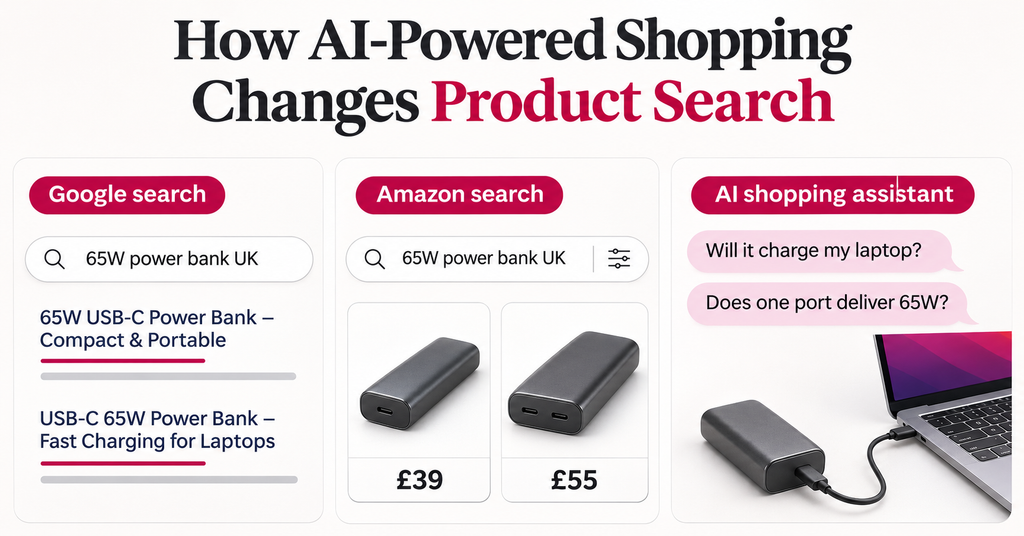
How AI-Powered Shopping Changes Product Search
| Where the buyer starts | Example | What to improve as a seller |
|---|---|---|
| Traditional Google search | “65W power bank UK” | Give the page a descriptive title, clear specifications and a current offer. Publish a buying guide if shoppers need help understanding wattage. |
| Amazon marketplace search | The buyer filters by price, scans ratings and opens two listings. | Make the model, pack contents, selected variant and delivered price easy to compare on a phone. |
| Conversational commerce | “Which of these will charge my laptop? Is the cheaper one enough? Do I need another cable?” | State the conditions behind each claim so the answer stays accurate as the buyer asks follow-up questions. |
These journeys overlap. Someone may discover a product in Google, compare it on Amazon and check the manufacturer’s website for compatibility. If those three places describe the same model differently, resolve that disagreement before investing in more traffic.
What Gives an AI Assistant a Credible Reason to Recommend Your Product?
Consider two illustrative listings. Both use the phrase “charges laptops”. Only one gives the buyer enough information to decide whether paying more makes sense.
| Buyer’s question | £39 model | £55 model |
|---|---|---|
| What can one port deliver? | “Up to 65W total.” Single-port output is unspecified. | “Up to 65W from USB-C port 1 when used on its own.” |
| What happens if I plug in my phone too? | The listing doesn’t say. | A power-sharing table shows how output changes when both ports are used. |
| Is the right cable included? | “Cable included.” Its rating is unspecified. | The box contents identify the supplied cable and its supported rating. |
For the buyer with the 65W laptop, the second listing is the more defensible choice. The cheaper model might also work, but its seller has left the deciding fact unanswered. For someone charging only a phone, the extra £16 may buy a capability they never use. An honest comparison should help both people choose.
Quality and trust signals that can be verified
“Premium construction” tells a shopper very little. These give them facts they can check:
- A published test, with its conditions
- An identifiable manufacturer
- Accessible warranty terms
- A clear route to customer support
Reviews add a different kind of evidence. If several owners mention that the device feels heavy in a commuter bag, publish its weight next to its dimensions. Don’t turn those opinions into a technical finding.
How to Improve Your Listings for AI Product Recommendations
For Amazon sellers: answer the question behind the search term
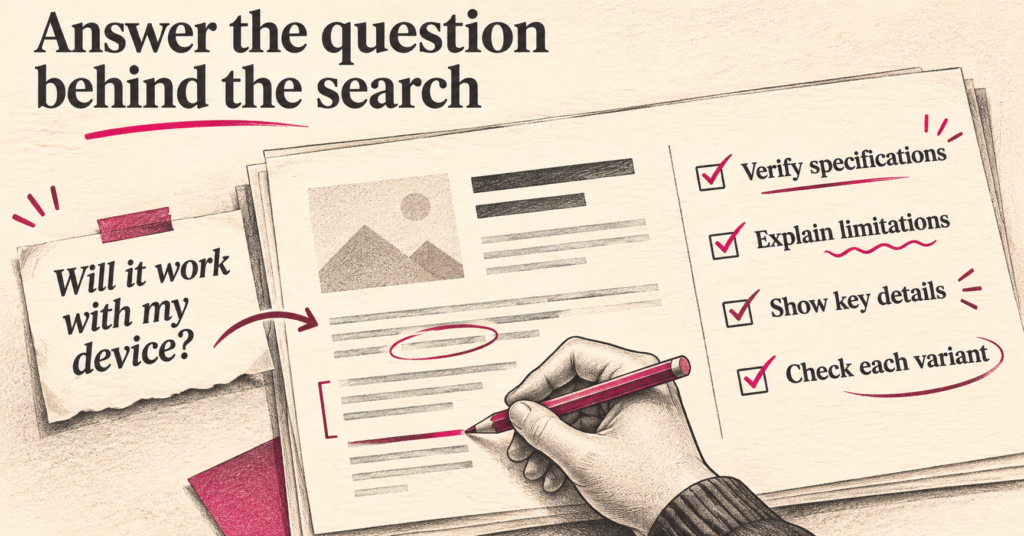
Start with one advertised product. Read the search terms that brought shoppers to it alongside the questions customers ask before buying. If shoppers arrive for “laptop power bank” and keep asking whether it can power a particular device, repeating “laptop” in the title achieves little. The missing information is compatibility.
What I’d do:
- Add the verified single-port output to the specifications.
- Explain the power-sharing limitation in a bullet point.
- Use a secondary image to show the ports.
- Check every variant. A review or image for a higher-powered model can create the wrong expectation when the buyer has selected the cheaper version.
Finally, look at the offer as a customer would. Amazon’s UK shopping assistant can compare products and show price history. If today’s price matches a previous offer, the case for buying may rest on the included cable, delivery date or warranty. Make whichever benefit is genuine easy to verify.
For Shopify stores: inspect what leaves your catalogue
A polished storefront can still have a variant called “Standard”, a missing barcode or an old description in a connected feed. Shopify recommends reviewing product titles, descriptions, images, identifiers and variant options. Eligible products can be discovered through Shopify Catalog and other routes, including feeds and web indexing. Availability varies by channel and store.
My first check would be to pick one SKU and compare four places: the Shopify product record, the published page, the connected feed and the basket. Do all four identify the same model at the same price? Then test a UK and a US destination if you serve both. Currency, shipping cost, delivery estimate and return arrangements can change which offer is best for a particular shopper.
Shopify also lets merchants maintain store-level information for AI channels through its knowledge base. That is a useful place for questions such as “Where do you ship?” Model-specific compatibility still belongs with the product itself.
For independent brands: give Google and the buyer consistent evidence
Google says its established SEO practices apply to AI Overviews and AI Mode, and that no special AI markup is needed for inclusion. Its merchant listing documentation explains how product and offer structured data can make a page eligible for shopping experiences. Eligibility gives Google a way to use the information. It does not guarantee a recommendation.
I’d prioritise four changes on an independent store:
- Put decisive specifications in readable page text. If dimensions, materials or compatibility appear only in a photograph, shoppers have to hunt for them. Use a short specification table and explain what the most important figure means in use.
- Align structured data, feeds and the live offer. Check the product identity, price, currency and availability for the selected variant. An advertised £39 price is frustrating when the linked model costs £55.
- Write comparison content that helps someone rule a product out. “Choose the smaller model if you only charge a phone” is useful advice. Include the conditions under which spending more makes sense.
- Publish answers and policies someone can verify. Use support questions for a concise FAQ. Identify who makes the product, who honours the warranty, what returns cost and how to reach a person. Keep manuals and comparison pages tied to the correct model number.
How to Test Whether AI Assistants Recommend Your Product
Choose a bestseller and a genuine alternative at a similar price. Give an assistant a realistic question without naming your brand. This tests product discovery. Then name both products and ask for a comparison. This tests whether the assistant can explain the difference once it knows what to compare.
| Ask the assistant | What to check |
|---|---|
| “Which power bank under £60 would suit a laptop that needs 65W?” | Does the shortlist match the budget and intended use? Which products or sources appear? |
| “Compare model A and model B. When is the extra £16 worth paying?” | Is the deciding specification correct for the exact variant? Can you verify it on the cited page? |
| “What else would I need to buy, and what would it cost delivered to my postcode?” | Are accessories, availability and delivery clear? Does the total match the basket? |
Record the date, country, prompt, answer and source. Mark each important claim correct, incorrect or unknown. If the assistant guesses, investigate whether your own information is missing or contradictory. If it answers correctly, record that too. A single response is a diagnostic clue, not a market-wide visibility score.
Connect the test to advertising performance
If PPC repeatedly brings laptop buyers to a page that leaves power output unclear, fix that uncertainty and monitor conversion for those searches. Watch compatibility questions and return reasons too. A page that helps an unsuitable buyer choose another model can prevent a costly return, even when its headline conversion rate stays flat.
What Comes Next for AI Shopping?
The next commercial question is what happens after the recommendation. Shopify describes agentic checkout rolling out to eligible Google users and stores. As discovery and purchase move closer together, stale inventory, unclear delivery terms or the wrong variant can affect the transaction itself. Rollout and availability still vary.
If you’re considering your next AI e-commerce investment, start with one product and one owner responsible for keeping its facts consistent across channels. Track:
- How accurately assistants describe the product
- What referred visitors buy, where that traffic is identifiable
- Why customers return it
Those measures tell you more about the AI shopping experience than counting brand mentions alone.
FAQs
Run an unbranded question using a realistic budget, use case and location. Then run a named comparison. Record whether the product appears, which variant is shown and whether the explanation is accurate. Repeat the same questions over time so you can spot changes.
Google says no special schema is required for its AI search features. Accurate Product and Offer structured data can support eligibility for relevant merchant listing experiences. Check that the markup agrees with what the shopper sees and can actually buy.
Amazon has documented using customer reviews alongside listing details and community questions in its shopping assistance. Reviews can reveal how a product performs in everyday use. For precise claims such as dimensions, compatibility or warranty coverage, publish a verifiable answer from the seller or manufacturer.
Yes. Shopify says eligible products can be discoverable through its catalogue, connected feeds and other discovery methods. Check eligibility for your store and market, then inspect the product data each channel receives. A complete catalogue improves the information available for matching. Each platform determines what it displays.

